
Digital marketing is moving beyond simply reaching the right audience—it is increasingly about understanding what each customer needs at the right moment. Artificial intelligence (AI) is playing a major role in this shift by helping businesses analyze customer behavior, automate tasks, create content, and deliver more relevant experiences.
According to McKinsey, 71% of consumers expect companies to deliver personalized interactions, while 76% become frustrated when those expectations are not met. This shows why personalization has become more than a marketing trend; it is becoming a customer expectation.[Resource]
Traditional personalization often relied on basic information such as a customer’s name, location, age, or previous purchases.
AI Agents and Hyper-Personalization take this idea much further. Instead of offering the same experience to broad customer segments, AI can analyze multiple signals—including browsing behavior, purchase history, preferences, interactions, and real-time activity—to help businesses tailor their communication and recommendations.
The rise of AI Agents and Hyper-Personalization is particularly important because AI agents can do more than provide information. They can interpret data, make decisions based on predefined goals, and take actions with limited human intervention.
For example, an AI agent could identify that a customer is repeatedly viewing a particular product category and help trigger a relevant recommendation, message, or offer.
This combination allows marketers to create customer journeys that feel more timely and relevant rather than generic.
AI Agents and Hyper-Personalization can support personalized emails, product recommendations, website experiences, advertisements, and customer service interactions.
In this blog, we’ll explore what AI agents are, how hyper-personalization works, and how these technologies are changing modern marketing. We’ll also look at their key benefits, practical examples, challenges, and what businesses can expect as AI-powered personalization continues to evolve.
What Are AI Agents?
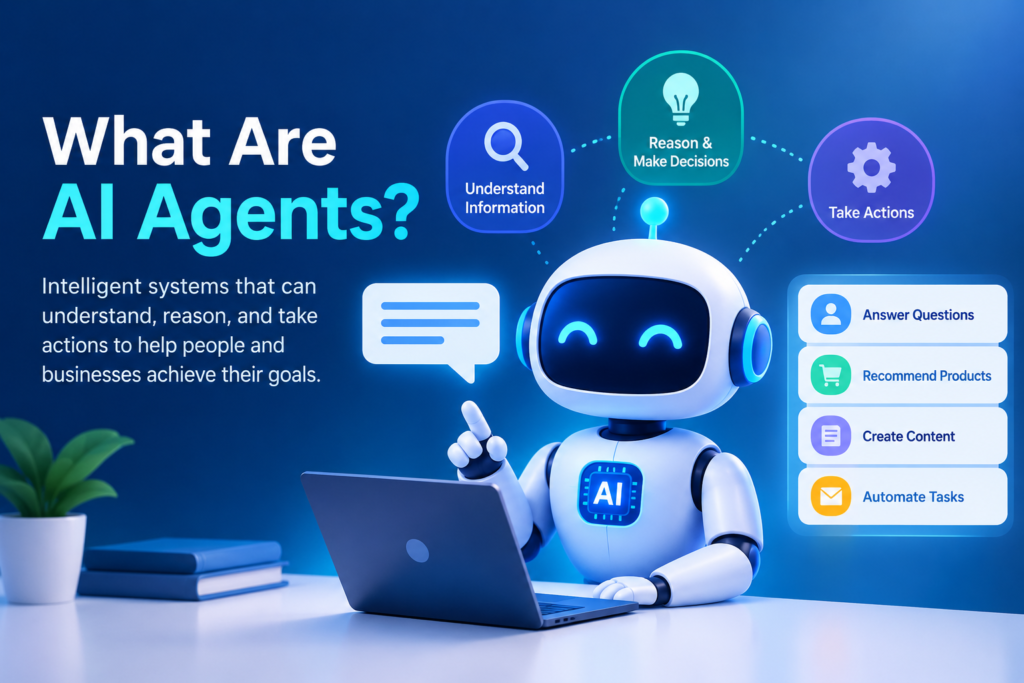
AI agents are software systems designed to understand a goal, process information, make decisions, and take actions to complete a task. Unlike a basic AI tool that may simply respond to a prompt, an AI agent can work through multiple steps to achieve an objective.
For example, instead of only generating an email, an AI agent could analyze customer information, identify an appropriate audience, create a personalized message, and help trigger the next marketing action.
The growing importance of AI Agents and Hyper-Personalization comes from their ability to work with large amounts of information and respond to changing customer behavior. An AI agent typically follows a cycle: observe → analyze → decide → act → learn or adjust.
It can examine information such as browsing activity, previous purchases, search behavior, or customer interactions and use those signals to determine the next appropriate action.
One important difference between traditional AI tools and AI agents is autonomy. A traditional AI tool usually performs a specific task when a person gives it an instruction. An AI agent, on the other hand, can be given a broader goal and determine the steps needed to accomplish it.
This does not mean agents should operate without supervision; businesses still need clear goals, permissions, data controls, and human oversight.
In marketing, AI agents can support tasks such as customer-service conversations, lead qualification, personalized product recommendations, campaign optimization, audience segmentation, and follow-up communication.
For instance, an AI agent could recognize that a visitor has repeatedly explored a particular service and help deliver content related to that interest rather than showing a generic message.
This is where AI Agents and Hyper-Personalization become closely connected. AI agents can process customer signals and help marketers respond to individual preferences at scale. Rather than manually analyzing thousands of interactions, marketers can use AI to identify patterns and turn those insights into relevant actions.
Ultimately, AI Agents and Hyper-Personalization are about making digital experiences more responsive.
The technology can help businesses understand not only who a customer is, but also what they are interested in right now. When used responsibly, this can make marketing feel less like mass communication and more like a useful, timely conversation.
What Is Hyper-Personalization?
Hyper-personalization is the next step beyond traditional personalization. It uses customer data, artificial intelligence, machine learning, and real-time behavioral signals to create marketing experiences that are highly relevant to individual users.
Instead of showing everyone the same message or simply adding a customer’s name to an email, hyper-personalization aims to understand what a customer wants, when they want it, and how they prefer to receive it.
Personalization vs. Hyper-Personalization
The difference can be understood with a simple example. Traditional personalization might send an email saying, “Hi Riya, here are some products you may like,” based on a previous purchase.
Hyper-personalization goes deeper by considering browsing history, previous purchases, content interactions, location, preferences, and current behavior before deciding what recommendation or message to show.
This is where AI Agents and Hyper-Personalization work together. AI can process large amounts of customer information and identify patterns that would be difficult to analyze manually.
AI agents can then use those insights to support more relevant actions across the customer journey.
The Role of Data and Real-Time Behavior
Customer data is the foundation of hyper-personalization. Information such as purchase history, website activity, search behavior, email interactions, and product preferences can help create a clearer picture of customer interests.
Real-time behavior makes the experience even more dynamic. For example, if someone is currently comparing laptops on an e-commerce website, the business could show relevant accessories, comparisons, or educational content rather than a generic advertisement.
AI Agents and Hyper-Personalization can also support personalized email recommendations, dynamic website content, tailored advertisements, product suggestions, and AI-powered customer service.
Streaming platforms recommending content based on viewing habits and online stores suggesting products based on browsing behavior are familiar examples of this approach.
Why Are Businesses Moving Toward Hyper-Personalization?
Customer expectations are a major reason. McKinsey research found that 71% of consumers expect personalized interactions, while 76% become frustrated when they don’t receive them.
The same research found that companies that excel at personalization generate 40% more revenue from personalization activities than average performers.
These figures help explain why businesses are investing in more advanced personalization strategies. AI Agents and Hyper-Personalization can help companies deliver relevant experiences at a scale that would be difficult to achieve through manual marketing alone.
However, effective hyper-personalization requires balance. Using customer information responsibly, respecting privacy, and avoiding overly intrusive messages are essential for maintaining trust.
When relevance and privacy work together, AI Agents and Hyper-Personalization can turn generic marketing into experiences that feel genuinely useful and timely.
How AI Agents Enable Hyper-Personalization?
The real power of AI Agents and Hyper-Personalization comes from their ability to turn customer data into timely, relevant actions.
Instead of relying only on information collected during a purchase or signup, AI agents can help analyze signals from different customer touchpoints and continuously adjust the experience.
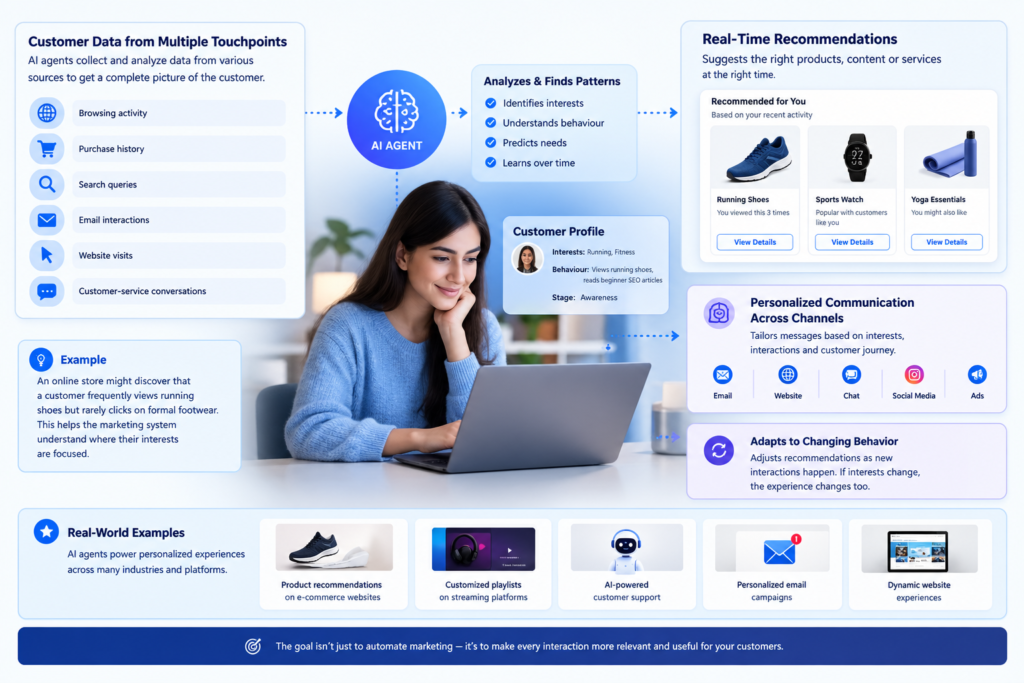
Collecting and Analyzing Customer Data
AI agents can work with information such as browsing activity, purchase history, search queries, email interactions, website visits, and customer-service conversations. They can identify patterns across these signals much faster than manual analysis.
For example, an online store might discover that a customer frequently views running shoes but rarely clicks on formal footwear.
This information can help the marketing system understand where that customer’s interests are focused.
Understanding User Behavior and Preferences
AI Agents and Hyper-Personalization become more effective when AI can interpret behavior rather than simply store customer information.
An agent can examine what a customer clicks, ignores, purchases, or searches for and use these signals to build a more relevant picture of their preferences.
For example, someone repeatedly reading beginner-level SEO articles may receive introductory resources rather than advanced technical content. Over time, the experience can change as the customer’s interests and behavior change.
Real-Time Recommendations
One of the biggest advantages is the ability to respond to behavior in real time. AI agents can help recommend products, content, or services based on what a customer is doing at that moment.
E-commerce platforms can suggest related products, while content platforms can recommend articles or videos based on recent interactions.
Personalized Communication Across Channels
AI agents can also support personalized communication through email, websites, chat, social media, and advertising platforms.
Instead of sending identical messages to every customer, businesses can tailor communication according to interests, previous interactions, and where a person is in the customer journey.
For instance, a visitor who has viewed a service page several times could receive educational content related to that service, while an existing customer could receive information about relevant upgrades or complementary services.
Adapting to Customer Interactions
The process does not have to remain static. AI Agents and Hyper-Personalization can continuously adapt as new interactions occur. If a customer loses interest in a particular product category, future recommendations can change.
If their activity shows increasing interest in another category, the system can adjust accordingly.
Real-World Examples
Common examples include personalized product recommendations on e-commerce websites, customized playlists and content suggestions on streaming platforms, AI-powered customer support, personalized email campaigns, and dynamic website experiences.
Ultimately, AI Agents and Hyper-Personalization help businesses move from a one-size-fits-all approach toward marketing experiences that can respond to individual behavior.
The goal is not simply to make marketing more automated, but to make each interaction more relevant and useful to the customer.
How Is AI Changing Personalized Marketing?
Artificial intelligence is changing personalized marketing by helping businesses understand customers at a much deeper level and respond to their needs more quickly.
Traditional marketing often depends on broad audience segments, while AI Agents and Hyper-Personalization allow marketers to work with detailed behavioral signals and deliver more relevant experiences at scale.
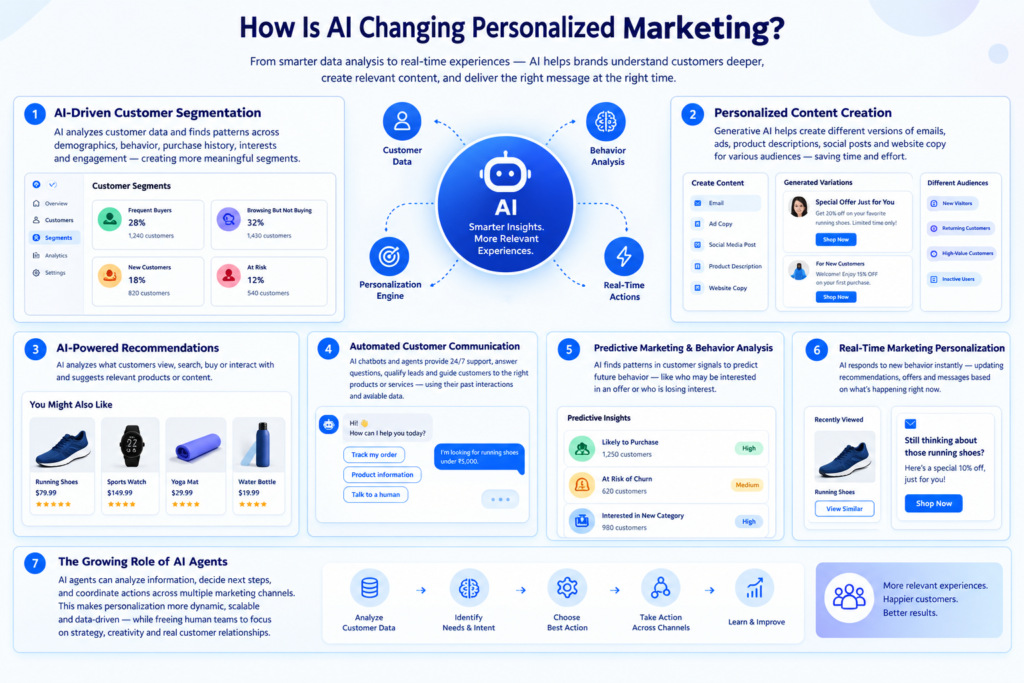
AI-Driven Customer Segmentation
AI can analyze customer information and identify patterns across demographics, browsing behavior, purchase history, interests, and engagement.
Instead of putting thousands of customers into a few broad categories, AI can help marketers create more meaningful segments based on actual behavior. These segments can then be used to deliver different messages, offers, or content.
Personalized Content Creation
Generative AI is also changing how marketers create content. It can help produce different versions of emails, advertisements, product descriptions, social media posts, and website copy for different audiences.
Marketers can then review and refine the content to maintain brand voice and quality. This makes it easier to create relevant content without manually writing every variation from scratch.
AI-Powered Recommendations
Recommendation systems are another major application. AI can analyze what customers have viewed, searched for, purchased, or interacted with and use those signals to suggest relevant products or content.
This is particularly common in e-commerce, streaming, and content platforms.
Automated Customer Communication
AI-powered chatbots and agents can communicate with customers around the clock. They can answer common questions, provide relevant information, qualify leads, and direct customers toward appropriate products or services.
With AI Agents and Hyper-Personalization, communication can become more contextual because the system can use available customer information and previous interactions.
Predictive Marketing and Behavior Analysis
AI can also help marketers identify patterns that may indicate future customer behavior.
For example, businesses can analyze engagement signals to identify customers who may be interested in a particular offer or those who have become less active.
These insights can support decisions about when and how to communicate with different audiences.
Real-Time Marketing Personalization
Customer interests can change quickly. AI allows marketing systems to respond to new behavior instead of relying entirely on older customer data.
A website might change recommendations after a customer searches for a new product, while an email campaign can adapt based on previous interactions.
The Growing Role of AI Agents
The evolution from AI tools to autonomous or semi-autonomous agents is making this process more dynamic. AI Agents and Hyper-Personalization can work together to analyze information, determine appropriate next steps, and support actions across multiple marketing channels.
Ultimately, AI Agents and Hyper-Personalization are shifting personalized marketing from static customer profiles toward more responsive, data-driven customer experiences.
The technology can help marketers scale personalization while allowing human teams to focus on strategy, creativity, oversight, and building genuine customer relationships.
What Are the Benefits of Hyper-Personalization?
Customers today interact with brands across websites, social media, email, search engines, and messaging platforms. Because of this, generic marketing messages can easily get lost in the noise.
AI Agents and Hyper-Personalization help businesses make these interactions more relevant by using customer information and behavior to deliver experiences that are better aligned with individual needs.
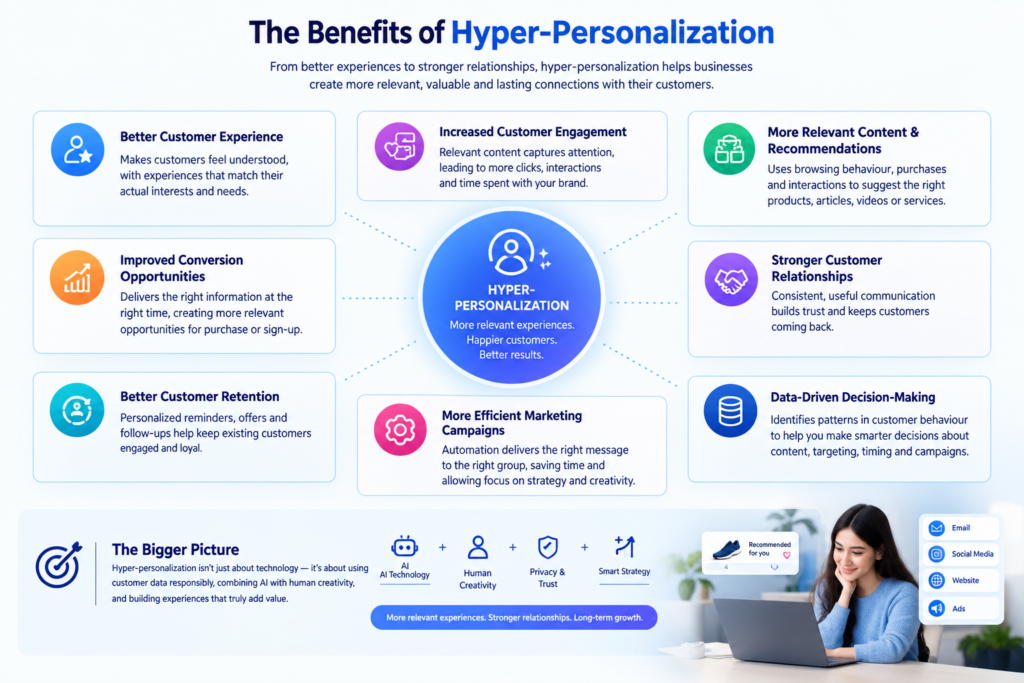
Better Customer Experience
Hyper-personalization can make customers feel understood rather than treated as just another number. When a website, email, or recommendation reflects a person’s actual interests, the overall experience can become more useful and convenient.
Increased Customer Engagement
Relevant content has a better chance of capturing attention. Instead of receiving messages about products or topics they do not care about, customers can be shown information that connects with their interests and current needs.
This can encourage more clicks, interactions, and time spent engaging with a brand.
More Relevant Content and Recommendations
One of the most visible benefits of AI Agents and Hyper-Personalization is improved recommendations. AI can use signals such as browsing behavior, previous purchases, and content interactions to suggest products, articles, videos, or services that are more relevant to a particular customer.
Improved Conversion Opportunities
When customers receive information that matches their needs, businesses may create more relevant opportunities for conversion.
For example, an online store can recommend complementary products after someone purchases an item, while a service business can provide content addressing a prospect’s specific problem.
Creating relevant content for different customer needs is an important part of modern content creation.
Stronger Customer Relationships
Personalized experiences can contribute to a stronger connection between customers and brands. When businesses consistently provide useful information instead of irrelevant promotional messages, customers may have more reasons to return and interact.
Better Customer Retention
Hyper-personalization can also support retention by helping businesses understand changing customer interests.
Personalized recommendations, timely reminders, relevant offers, and helpful follow-up communication can keep existing customers engaged.
More Efficient Marketing Campaigns
AI can reduce the amount of manual work involved in analyzing audiences and creating multiple marketing variations. Marketers can use automation to deliver different messages to different customer groups while spending more time on strategy and creative decisions.
Data-Driven Decision-Making
Another important benefit is better use of customer data.
AI Agents and Hyper-Personalization can help marketers identify patterns in customer behavior and use those insights to make informed decisions about content, targeting, timing, and campaigns.
Overall, AI Agents and Hyper-Personalization can help businesses move beyond mass marketing toward more relevant customer experiences. The goal is not personalization for its own sake, but using technology responsibly to make every interaction more useful.
When combined with human creativity, privacy-conscious data practices, and thoughtful strategy, hyper-personalization can become a valuable part of modern digital marketing.
AI Agents vs. Traditional Personalization
Personalization is not a new concept in marketing. Businesses have used customer names, demographics, purchase history, and previous interactions for years to make their communication more relevant.
However, the combination of AI Agents and Hyper-Personalization is changing how deeply and quickly businesses can personalize customer experiences.
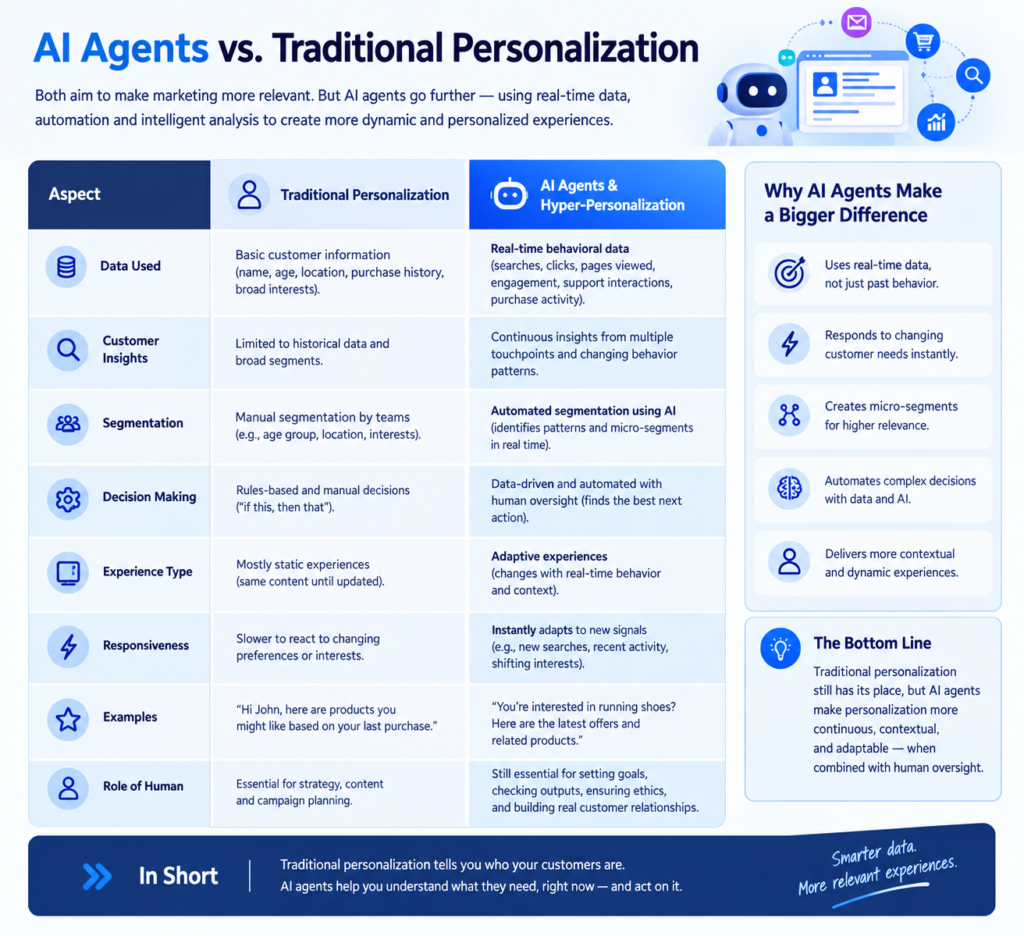
Traditional Personalization Uses Basic Customer Information
Traditional personalization generally relies on information that is already available, such as a customer’s name, age group, location, previous purchases, or broad interests.
For example, an online store might recommend products based on what a customer purchased last month. While useful, this approach can become limited when customer preferences change quickly.
AI Agents Use Real-Time Behavioral Data
AI agents can consider a much wider range of signals, including recent searches, pages viewed, clicks, purchase activity, content engagement, and interactions with customer support.
This allows AI Agents and Hyper-Personalization to respond to what customers are doing now rather than relying only on historical information.
Imagine a customer who normally purchases formal clothing but suddenly starts searching for running shoes. A traditional system might continue recommending formalwear based on previous purchases.
An AI-powered system can recognize the change in behavior and adjust future recommendations accordingly.
Automated Decisions vs. Manual Segmentation
Traditional marketing often requires teams to create audience segments manually and decide which message should go to each group.
AI agents can automate parts of this process by analyzing large datasets, identifying patterns, and helping determine appropriate next actions.
However, automation does not eliminate the need for marketers. Human oversight remains important for setting objectives, checking outputs, managing customer data, and ensuring that automated decisions align with business and ethical requirements.
Static vs. Adaptive Experiences
Traditional personalization can produce relatively static experiences. Once a customer is placed into a segment, they may continue receiving the same type of content until the segment is manually updated.
In contrast, AI Agents and Hyper-Personalization can support adaptive experiences. As customer behavior changes, recommendations, messages, and content can change with it.
This creates a customer journey that is more responsive rather than fixed.
Why AI Agents Support Dynamic Personalization
The key difference is the ability to combine data, context, automation, and real-time responses. AI agents can help businesses process numerous customer signals and act on relevant information much faster than manual processes typically allow.
Ultimately, AI Agents and Hyper-Personalization represent an evolution from simply knowing basic customer details to responding intelligently to changing customer behavior.
Traditional personalization still has its place, but AI agents can make personalization more continuous, contextual, and adaptable when implemented with appropriate human oversight.
Real-World Examples of AI-Powered Hyper-Personalization
AI-powered hyper-personalization is no longer limited to experimental marketing strategies. People experience it every day while shopping online, watching videos, reading content, or interacting with brands.
The combination of AI Agents and Hyper-Personalization allows businesses to respond to customer behavior and create experiences that feel more relevant to individual needs.
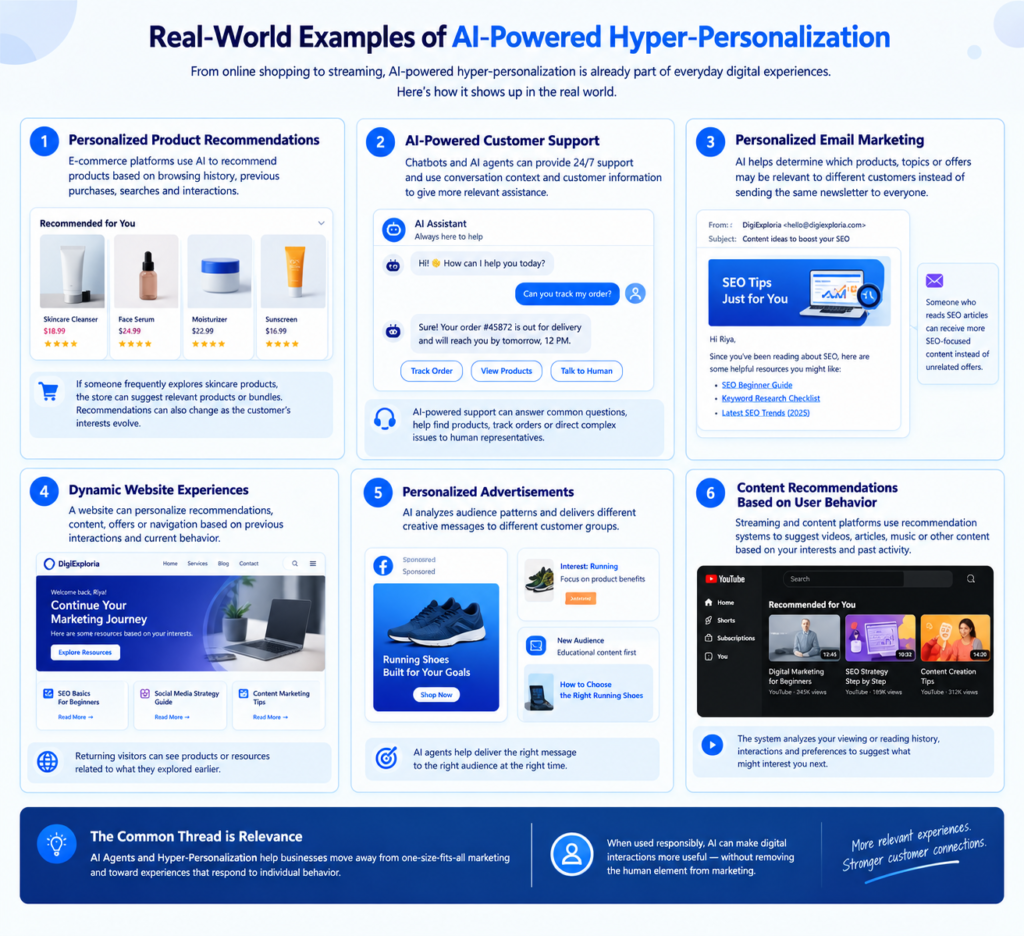
Personalized Product Recommendations
E-commerce platforms use AI to recommend products based on browsing history, previous purchases, searches, and interactions.
For example, if someone frequently explores skincare products, an online store can recommend related products or bundles. With AI Agents and Hyper-Personalization, recommendations can also change as the customer’s interests change.
AI-Powered Customer Support
AI-powered chatbots and agents can provide customer support at any time of the day. Instead of giving every customer the same response, AI systems can use the context of a conversation and available customer information to provide more relevant assistance.
They can answer common questions, help customers find products, track orders, or direct complex issues to human representatives.
Personalized Email Marketing
Email marketing becomes more effective when messages are based on individual interests and actions. Rather than sending the same newsletter to an entire subscriber list, businesses can use AI to determine which products, topics, or offers may be relevant to different customers.
For example, someone who repeatedly reads articles about SEO could receive more SEO-focused resources instead of unrelated content.
Dynamic Website Experiences
A website does not always need to look identical for every visitor. AI-powered systems can help personalize recommendations, content, offers, or navigation based on previous interactions and current behavior.
A returning visitor might see products or resources related to what they explored during an earlier visit.
Personalized Advertisements
AI can help advertisers identify audience patterns and deliver different creative messages to different customer groups.
For example, someone who has shown interest in a particular service may see an advertisement focused on its benefits, while another customer may receive educational content first.
AI Agents and Hyper-Personalization can support this process by helping marketers respond to changing audience signals.
Content Recommendations Based on User Behavior
Streaming and content platforms commonly use recommendation systems to suggest videos, articles, music, or other content. These systems can analyze viewing or reading history, interactions, and preferences to predict what might interest a user next.
The common thread across these examples is relevance. AI Agents and Hyper-Personalization can help businesses move away from one-size-fits-all marketing and toward experiences that respond to individual behavior.
When used responsibly, AI Agents and Hyper-Personalization can make digital interactions more useful without removing the human element from marketing.
Challenges of AI Agents and Hyper-Personalization
Although AI Agents and Hyper-Personalization can help businesses create more relevant customer experiences, they also introduce important challenges.
Collecting more data and automating more decisions does not automatically lead to better marketing. Businesses need to consider privacy, accuracy, transparency, and human oversight at every stage.
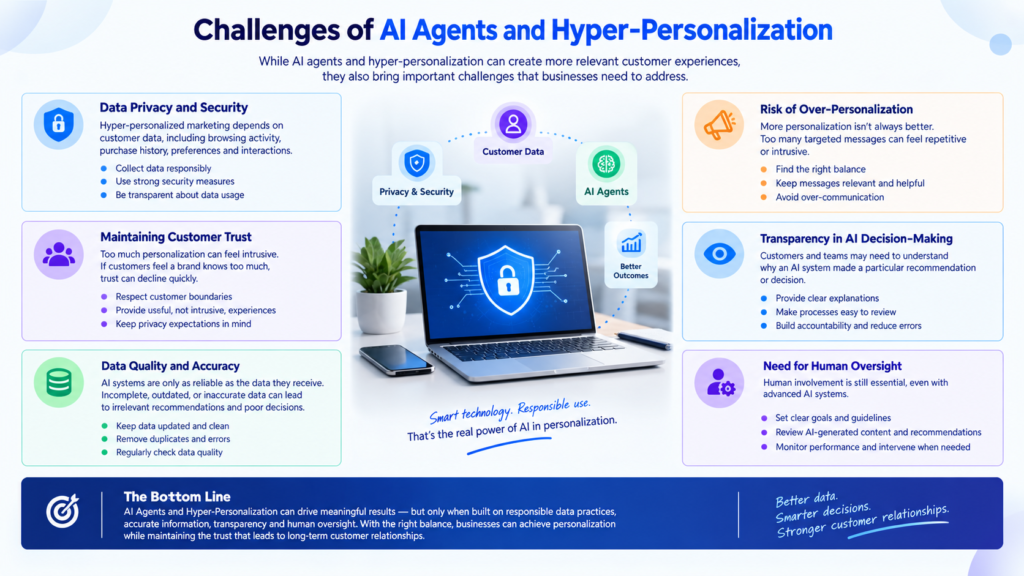
Data Privacy and Security
Hyper-personalized marketing depends heavily on customer data, including browsing activity, purchase history, preferences, and interactions.
Collecting and storing this information creates responsibilities around privacy and security. Businesses need appropriate safeguards and should be clear about what information they collect and how it is used.
Maintaining Customer Trust
Customers may appreciate relevant recommendations, but personalization can feel uncomfortable when it becomes too intrusive. If a customer feels that a brand knows too much about their personal behavior, trust can quickly decline.
AI Agents and Hyper-Personalization should therefore focus on providing useful experiences while respecting customer expectations and privacy.
Data Quality and Accuracy
AI systems are only as reliable as the information they receive. Incomplete, outdated, duplicated, or inaccurate customer data can lead to irrelevant recommendations and poor decisions.
For example, recommending products based on an old purchase may not reflect what a customer wants today. Regular data maintenance and quality checks are therefore essential.
Risk of Over-Personalization
More personalization is not always better. Showing customers highly targeted messages too frequently can make marketing feel repetitive or intrusive. Businesses need to find the right balance between relevance and simplicity.
A personalized experience should feel helpful rather than as though every customer action is being monitored.
Transparency in AI Decision-Making
Another challenge is understanding why an AI system made a particular recommendation or decision. Customers and marketing teams may need clear explanations about how automated systems use information. Transparent processes can make it easier to identify errors and maintain accountability.
Need for Human Oversight
Despite advances in AI, human involvement remains important. Marketers should establish clear goals, review AI-generated content and recommendations, monitor automated actions, and intervene when necessary.
AI Agents and Hyper-Personalization should support human decision-making rather than completely replace it.
Ultimately, successful AI Agents and Hyper-Personalization require more than sophisticated technology. Businesses need responsible data practices, accurate information, transparency, and appropriate human supervision.
When these foundations are in place, organizations can pursue personalization while maintaining the trust that makes long-term customer relationships possible.
The Future of AI Agents and Hyper-Personalization
The future of digital marketing is moving toward experiences that are not only personalized but also increasingly responsive to individual customer needs.
As AI technology develops, AI Agents and Hyper-Personalization are expected to become more closely connected, helping businesses understand customers, make faster decisions, and deliver relevant experiences across multiple touchpoints.
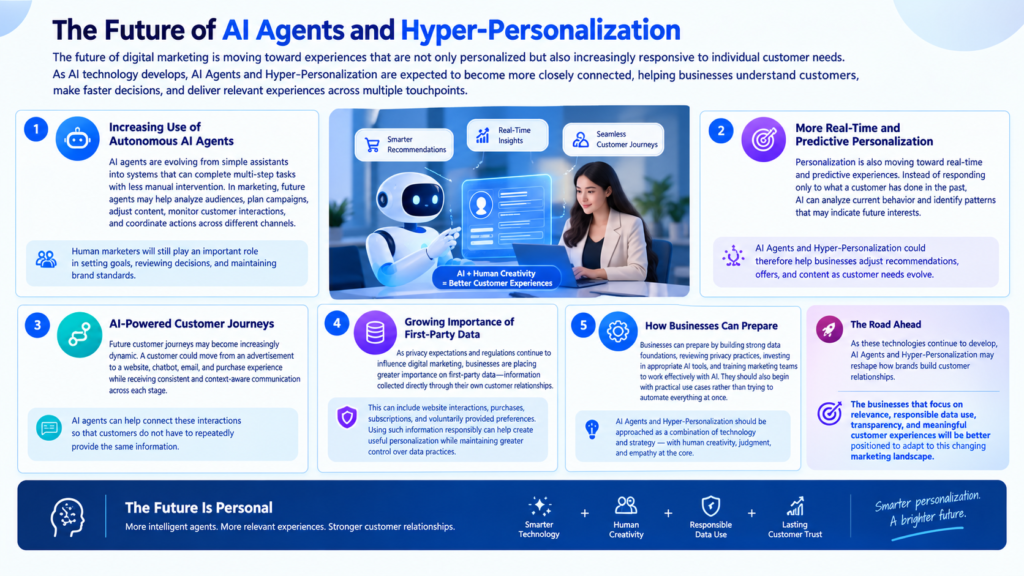
Increasing Use of Autonomous AI Agents
AI agents are evolving from simple assistants into systems that can complete multi-step tasks with less manual intervention. In marketing, future agents may help analyze audiences, plan campaigns, adjust content, monitor customer interactions, and coordinate actions across different channels.
Human marketers will still play an important role in setting goals, reviewing decisions, and maintaining brand standards.
More Real-Time and Predictive Personalization
Personalization is also moving toward real-time and predictive experiences. Instead of responding only to what a customer has done in the past, AI can analyze current behavior and identify patterns that may indicate future interests.
AI Agents and Hyper-Personalization could therefore help businesses adjust recommendations, offers, and content as customer needs evolve.
AI-Powered Customer Journeys
Future customer journeys may become increasingly dynamic. A customer could move from an advertisement to a website, chatbot, email, and purchase experience while receiving consistent and context-aware communication across each stage.
AI agents can help connect these interactions so that customers do not have to repeatedly provide the same information.
Growing Importance of First-Party Data
As privacy expectations and regulations continue to influence digital marketing, businesses are placing greater importance on first-party data—information collected directly through their own customer relationships.
This can include website interactions, purchases, subscriptions, and voluntarily provided preferences. Using such information responsibly can help businesses create useful personalization while maintaining greater control over their data practices.
How Businesses Can Prepare
Businesses can prepare for the next generation of personalized marketing by building strong data foundations, reviewing their privacy practices, investing in appropriate AI tools, and training marketing teams to work effectively with AI.
They should also begin with practical use cases rather than trying to automate everything at once.
Most importantly, AI Agents and Hyper-Personalization should be approached as a combination of technology and strategy.
AI can process information and automate actions, but businesses still need human creativity, judgment, and empathy to understand what customers genuinely value.
As these technologies continue to develop, AI Agents and Hyper-Personalization may reshape how brands build customer relationships.
The businesses that focus on relevance, responsible data use, transparency, and meaningful customer experiences will be better positioned to adapt to this changing marketing landscape.
Conclusion
The relationship between AI Agents and Hyper-Personalization is changing the way businesses think about customer engagement. Traditional personalization focused mainly on basic customer information and predefined audience segments.
AI agents take this further by analyzing behavioral signals, understanding context, and helping businesses respond to changing customer needs in a more dynamic way.
By combining customer data, artificial intelligence, and real-time interactions, AI Agents and Hyper-Personalization can help businesses deliver more relevant content, recommendations, communication, and customer support.
Whether it is suggesting a product, personalizing an email, adapting a website, or answering a customer’s question, AI can make digital experiences more responsive and useful.
For marketers, understanding these technologies is becoming increasingly important. AI is not simply another automation tool; it is influencing how audiences are segmented, how content is created, how campaigns are optimized, and how customer journeys are managed.
Marketers who understand both the opportunities and limitations of AI can make better strategic decisions while keeping human creativity and judgment at the center.
At the same time, effective personalization requires responsibility. Businesses must protect customer data, maintain transparency, avoid intrusive experiences, and ensure that AI-generated decisions are appropriately monitored.
Technology should enhance the customer relationship rather than make it feel less human.
Looking ahead, AI Agents and Hyper-Personalization are likely to become an increasingly important part of digital marketing as AI systems become more capable and customer expectations continue to evolve.
The future of personalized marketing will not simply be about using more data or automation—it will be about using technology intelligently to create experiences that are relevant, timely, helpful, and genuinely valuable.