
You’re posting on Instagram, improving your website, working on SEO, and even spending money on ads. Your brand is getting impressions, clicks, views, and maybe even a few likes.
But when you check your inbox or CRM, there are still not enough people asking about your products or services.
If this sounds familiar, you’re not alone.
One of the most frustrating situations for a business owner is investing time and money into marketing without seeing a clear return. The problem, however, isn’t always that digital marketing doesn’t work.
In many cases, the real issue is that digital marketing is not generating leads because one or more parts of the customer journey are not working together.
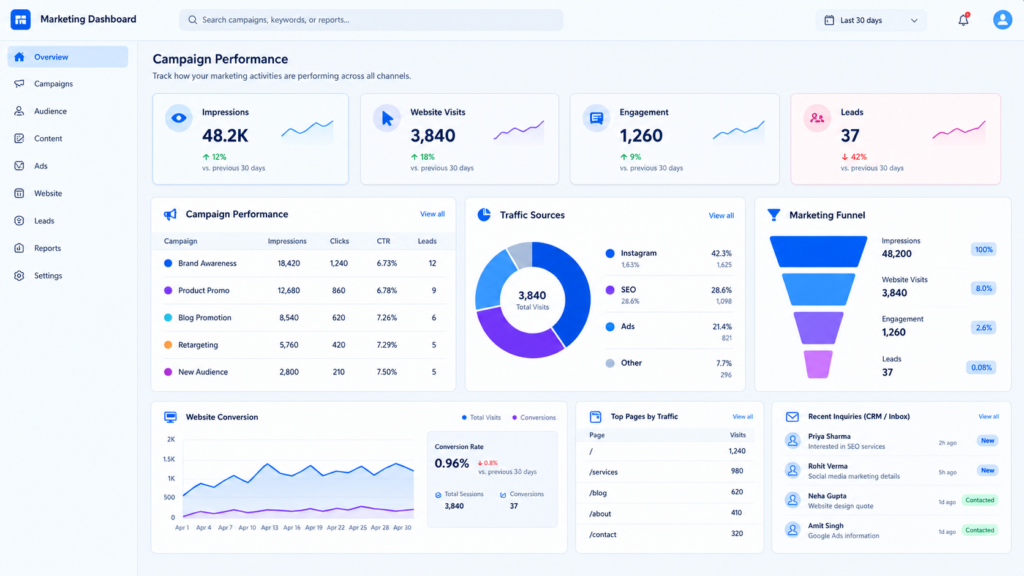
Think of digital marketing as a complete journey rather than a collection of separate activities. Social media can create awareness, SEO can bring people to your website, content can build trust, and advertising can attract potential customers.
But visibility alone doesn’t guarantee conversion.
For example, HubSpot’s 2026 marketing data identifies website, blog, and SEO as the #1 ROI-generating channel reported by marketers, while paid social follows closely behind at 26%. [Resource]
This shows that businesses continue to see value in digital channels—but the results depend on how strategically those channels are used.
So, if your digital marketing is not generating leads, don’t immediately assume you need to spend more money or post more frequently.
First, find the point where potential customers are dropping off.
In this article, we’ll look at the most common reasons businesses struggle to generate leads online—from targeting the wrong audience and having a weak strategy to poor website conversion, ineffective SEO, and weak follow-up.
The goal is simple: help you understand why your digital marketing is not generating leads and what you can check before increasing your marketing budget.
Why Digital Marketing Is Not Working?
When business owners say, “My marketing isn’t working,” they often look at the final result—not enough leads. But lead generation is the final outcome of several smaller steps.
A potential customer might first discover your Instagram post, search for your business on Google, visit your website, read a blog, compare you with competitors, and then finally contact you.
If even one important step is weak, your overall lead generation can suffer.
This is why digital marketing not generating leads is rarely caused by one single problem.
Your audience may be wrong. Your strategy may lack a clear goal. Your content may get attention but fail to encourage action. Your website may receive visitors but not convert them. Your SEO may attract people who aren’t ready to buy.
Your ads may generate clicks without producing qualified inquiries. Or perhaps you’re getting leads but not following up effectively.
Data also shows why businesses should look beyond traffic alone. HubSpot’s latest website research notes that sales, leads, and conversion rates are among the most important performance metrics marketers track.
It also reports that more than 60% of marketers say inbound strategies such as SEO and content produce their highest-quality leads.[Resource]
That means getting 10,000 visitors isn’t automatically better than getting 1,000 relevant visitors. The more important question is: Are the right people taking the right action?
If your digital marketing is not generating leads, start by checking these seven areas:
- Wrong Target Audience — Are you reaching people who actually need your product or service?
- Poor Digital Marketing Strategy — Do your channels work toward a common business goal?
- Content That Doesn’t Convert — Does your content encourage potential customers to take action?
- A Website That Doesn’t Convert — Can visitors quickly understand what you offer and how to contact you?
- Weak SEO Targeting — Are you attracting relevant searches and the right search intent?
- Ineffective Advertising — Are your campaigns optimized for leads rather than simply clicks or impressions?
- Poor Follow-Up — What happens after someone shows interest?
Finding the weak point is the first step toward turning marketing activity into measurable business results. Instead of asking only, “Why am I not getting leads?”, start asking where in my marketing journey are potential customers losing interest?
1. Wrong Target Audience
Are You Reaching the People Who Actually Need Your Product?
One of the first things to check when your digital marketing is not generating leads is whether you’re reaching the right audience.
Many businesses assume that reaching more people automatically means getting more customers. But in digital marketing, relevance matters more than reach.
Imagine you run a digital marketing agency for small businesses, but your content and advertisements are mostly reaching college students who are looking for digital marketing courses.
Your posts might receive views, likes, and even website visits, but those people may not need your services. The result? Plenty of activity, but very few qualified inquiries.
This is the difference between audience reach and relevant audience reach. Audience reach tells you how many people saw your content. Relevant reach tells you how many of those people are actually potential customers.
Why Identifying Your Ideal Customer Matters
Before creating content or launching an advertising campaign, define who you want to attract. Think about their:
- Age and location
- Profession or business type
- Interests and buying behaviour
- Problems and challenges
- Budget and purchasing ability
- Needs and expectations
For example, a local clothing store and a B2B software company may both use Instagram, but they need completely different audiences, messages, offers, and content strategies.
When digital marketing not generating leads becomes a recurring problem, targeting everyone can make the situation worse. Broad targeting may increase impressions while reducing the relevance of your traffic. You could end up spending your budget on people who were never likely to become customers.
Use Customer Research Instead of Guesswork
Customer research can help you understand what your potential customers actually want. Look at your existing customers and identify common patterns.
What problem were they trying to solve? What made them choose your business? What questions did they ask before buying?
You can also use website analytics, social media insights, customer reviews, surveys, search queries, and conversations with your sales team to find these patterns.
This matters because social media has become an important discovery channel. HubSpot’s 2025 research found that 64% of Gen Z, 59% of Millennials, and 47% of Gen X respondents had discovered a product on social media in the previous three months.
But discovery doesn’t automatically mean conversion.
If your digital marketing is not generating leads, ask yourself: “Am I reaching more people, or am I reaching more of the right people?”
The goal isn’t to make your audience as large as possible. It’s to build an audience that has a genuine reason to care about what you offer.
When the right audience sees the right message at the right time, your chances of generating relevant leads become much stronger.
2. Poor Digital Marketing Strategy
Why Posting and Advertising Without a Strategy Can Hurt Your Results
You can post consistently, run advertisements, publish blogs, and stay active on social media—and still wonder why your digital marketing not generating leads.
The problem may not be how much marketing you’re doing, but whether all your efforts are working toward the same goal.
A digital marketing strategy gives your marketing activities direction. Without one, businesses often move from one trend to another: posting because competitors are posting, running ads because sales are slow, or creating reels simply because short-form video is popular. These activities may create attention, but they don’t necessarily create a clear path to conversion.
Start With Clear Marketing Goals
Before deciding what to post or where to advertise, define what you want your marketing to achieve.
Your goal could be:
- Generate qualified leads
- Increase website inquiries
- Build brand awareness
- Increase online sales
- Generate consultation bookings
- Grow a local customer base
A goal such as “get more followers” is very different from “generate 30 qualified inquiries per month.” Both can be measured, but they lead to very different strategies.
When digital marketing not generating leads becomes a concern, revisit your goals first. If your team is measuring followers while the business actually needs customers, your marketing may be optimized for the wrong outcome.
Keep Your Message Consistent
Your customers may discover your business on Instagram, search for you on Google, visit your website, and then see one of your advertisements.
If every platform communicates something completely different, it can create confusion.
Your brand should maintain consistency in its:
- Core message
- Visual identity
- Tone of communication
- Services and offers
- Value proposition
- Customer promises
Consistency doesn’t mean copying the same post everywhere. It means giving customers a recognizable and connected brand experience across channels.
Don’t Measure Success Only Through Likes and Views
Likes, comments, views, and followers can tell you something about engagement, but they don’t automatically tell you whether your marketing is generating business.
For lead generation, also monitor metrics such as qualified leads, conversion rate, cost per lead, website inquiries, bookings, and sales.
For example, a post with 10,000 views and zero inquiries may have created awareness but failed to generate a measurable business action.
Another post with 1,000 targeted views and 15 inquiries could be much more valuable from a lead-generation perspective.
Connect Every Marketing Channel
Your content, SEO, advertising, website, and conversion strategy shouldn’t operate as separate activities.
A potential customer might discover your Instagram content, search for your service on Google, read your blog, visit your website, and finally fill out a contact form.
That’s why, when digital marketing is not generating leads, you should examine the complete customer journey—not just one platform.
Think of your strategy as a connected system:
Content → SEO/Ads → Website → CTA → Lead → Follow-Up
If one part is disconnected, potential customers can drop out before becoming leads.
The goal isn’t simply to market your business everywhere. It’s to make every marketing activity contribute to a clear business objective.
When digital marketing not generating leads is the problem, more posting isn’t always the answer. A better strategy may be to make the marketing you are already doing more focused, connected, and measurable.
3. Your Content Isn’t Generating Leads
Are You Creating Content for Attention or Action?
Your content may be getting views, likes, shares, and followers, but if those numbers aren’t translating into inquiries or sales, something may be missing. This is one of the common reasons businesses find their digital marketing not generating leads.
The problem isn’t necessarily that your content is bad. It may simply be created for the wrong purpose.
There is a difference between creating content that gets attention and creating content that encourages action.
Educational vs. Promotional Content
Educational content helps your audience understand a problem, answer a question, or learn something useful.
Promotional content, on the other hand, introduces your product or service and encourages people to consider taking action.
You need a balance between both.
For example, a digital marketing agency could create an educational post titled:
“5 Reasons Your Instagram Posts Aren’t Generating Customers.”
A promotional post could then introduce its social media marketing service and explain how the business can help solve those problems.
If every post is promotional, people may feel like they’re constantly being sold to.
But if every post is educational and never introduces your services, interested prospects may not know how to work with you.
When digital marketing not generating leads becomes a problem, review your content mix and ask whether you’re educating, building trust, and creating opportunities to take action.
Create Content Around Real Customer Problems
The easiest way to make content more relevant is to start with your audience’s problems.
Instead of asking, “What should we post today?”, ask:
“What is our customer struggling with today?”
A small business owner might be struggling with low Instagram engagement, expensive advertising, poor website traffic, or inconsistent sales.
These problems can become valuable content topics.
Customer reviews, FAQs, sales conversations, social media comments, search queries, and competitor questions can all help you identify topics your audience genuinely cares about.
Useful content also supports trust. Google’s guidance encourages businesses to create helpful, reliable, people-first content rather than content created primarily to manipulate search rankings.
Use Strong Hooks and Deliver Real Value
Your hook is what makes someone stop scrolling, but the information that follows determines whether they stay.
A strong hook could be:
“Getting Instagram Views But No Customers?”
But the rest of the post needs to explain why that might be happening and what the audience can do about it.
Avoid creating a dramatic headline and then delivering generic advice. Give people something useful—an example, checklist, mistake to avoid, process, or practical solution.
Give People a Clear Next Step
Even valuable content can fail to generate leads if people don’t know what to do next.
Use relevant CTAs such as:
- Book a consultation
- Get a free audit
- Visit our website
- Send us a message
- Request a quote
- Learn more about our services
Your CTA should match the content and the audience’s level of interest. Someone reading an introductory educational blog may not be ready to purchase immediately, while someone comparing service providers may be ready for a consultation.
If your digital marketing is not generating leads, look beyond your reach and engagement numbers. Ask whether your content takes people from attention → value → trust → action.
Ultimately, content should do more than fill your social media calendar.
It should help the right people recognize a problem, understand your solution, trust your expertise, and know exactly what step to take next.
That’s how content can become part of a genuine lead-generation system rather than simply another source of online activity.
4. Your Website Isn’t Converting Visitors Into Leads
Why Website Traffic Doesn’t Always Mean More Customers
Getting people to your website is a positive sign, but traffic alone doesn’t guarantee leads. You might have visitors coming from Google, Instagram, Facebook, or paid advertisements and still find your digital marketing not generating leads.
The reason could be your website.
Think of your website as the place where your marketing efforts need to turn attention into action. Your social media may attract someone, your SEO may bring them to Google, and your advertisement may convince them to click.
But once they arrive, your website has to answer their questions and make the next step easy.
Is Your Messaging Clear?
A visitor should be able to understand what your business offers within a few seconds.
If your homepage contains vague statements such as “We deliver innovative solutions for modern businesses” without explaining what you actually provide, visitors may have to search for the answer themselves.
Your website should clearly communicate:
- What you offer
- Who you help
- What problem you solve
- Why customers should consider you
- What they should do next
Clear messaging reduces confusion and helps visitors quickly decide whether your business is relevant to them.
Do You Have a Strong CTA?
A website without a clear call-to-action (CTA) can leave interested visitors unsure about what to do.
Instead of making visitors search for your contact details, guide them with relevant actions such as:
Get a Quote | Book a Consultation | Contact Us | Request an Audit | Get Started
Your CTA should also match the visitor’s intent. Someone who is discovering your business for the first time may prefer “Learn More,” while someone ready to discuss a project may respond better to “Book a Consultation.”
When digital marketing not generating leads becomes a recurring issue, review the CTAs on your homepage, service pages, and landing pages.
Don’t Make Contact Forms Complicated
Every extra field can create friction.
If someone only wants to ask about your services, asking for their name, email, phone number, company size, address, budget, job title, and several other details may discourage them from completing the form.
Ask only for information you genuinely need at that stage.
Don’t Ignore Mobile Users
Your website may look perfect on a desktop but feel difficult to use on a smartphone.
Check whether:
- Text is easy to read
- Buttons are easy to tap
- Images load properly
- Menus work correctly
- Forms are simple to complete
- Important information appears without excessive scrolling
Google uses mobile-first indexing, meaning it primarily uses the mobile version of a site’s content for indexing and ranking.
Make Your Landing Pages Fast and Simple
When someone clicks an advertisement or search result, they should land on a page that matches what they expected.
For example, if your ad promotes SEO services for small businesses, sending visitors to a generic homepage can create unnecessary friction. A dedicated SEO landing page can explain the service, benefits, proof, and next step more clearly.
Page speed also matters. Google’s web performance guidance emphasizes metrics such as Largest Contentful Paint (LCP), Interaction to Next Paint (INP), and Cumulative Layout Shift (CLS) as important aspects of the user experience.
Build Trust Before Asking for Action
People are more likely to contact a business when they feel confident about it.
Add relevant trust signals such as:
- Customer testimonials
- Reviews
- Case studies
- Portfolio examples
- Certifications
- Client logos, where appropriate
- Clear service information
- Frequently asked questions
These elements help answer the customer’s unspoken question: “Can I trust this business to solve my problem?”
If your digital marketing is not generating leads, don’t only look at how many people are visiting your website. Look at what happens after they arrive.
Your goal is to create a smooth journey:
Traffic → Clear Message → Relevant Offer → Trust → CTA → Lead
When digital marketing not generating leads is the problem, your website may be the missing link between marketing activity and actual business inquiries.
5. Your SEO Isn’t Bringing the Right Traffic
Are You Ranking for the Right Keywords?
Getting your website to appear on Google is useful, but ranking alone doesn’t guarantee customers.
If your digital marketing is not generating leads, your SEO strategy may be attracting visitors who are interested in information but have little intention of buying your product or service.
This is where the difference between traffic and qualified traffic becomes important.
Imagine you run a digital marketing agency and rank for the keyword “what is digital marketing?” You may receive thousands of visitors over time, but many of them could be students, researchers, or people simply looking for a definition.
Now compare that with someone searching “digital marketing agency for small business”. The second search suggests a much stronger connection to a potential service need.
More traffic isn’t automatically better traffic.
Understand Search Intent
Search intent is the reason behind a person’s search.
Someone searching “how to improve Instagram engagement” may be looking for educational information. Someone searching “social media marketing agency near me” may already be comparing service providers.
Understanding this difference helps you create content for people at different stages of the buying journey.
Google’s current Search guidance emphasizes creating helpful, reliable, people-first content and making sure your pages are useful to the people who visit them.
So, instead of choosing keywords only because they have high search volume, ask:
“Does this keyword represent a problem my business can actually solve?”
Target Keywords Relevant to Your Business
When digital marketing not generating leads is a recurring concern, review the keywords bringing visitors to your website.
Look for keywords connected to:
- Your products or services
- Your target audience
- Your location, if you serve a specific area
- Customer problems
- Buying or comparison intent
- Questions related to your expertise
For example, a website design agency might target terms such as “website design services for small businesses” rather than focusing only on broad terms such as “website.”
The more closely your keyword matches your actual offering, the easier it becomes to create a relevant customer journey.
Create Content Around Real Customer Questions
Your customers are constantly asking questions—and those questions can become valuable SEO content.
If your audience frequently asks:
“How much does SEO cost?”
“How long does SEO take?”
“Why isn’t my website getting traffic?”
“How can I get more leads from Google?”
These can become blog topics, FAQ sections, guides, or service-page content.
This approach also helps you create content based on genuine customer needs rather than writing articles simply to include keywords.
Google’s Search documentation also warns against keyword stuffing, including repeating phrases so frequently that the writing becomes unnatural.
Connect SEO Traffic With Conversion-Focused Pages
One of the biggest mistakes businesses make is treating a blog visit as the final goal.
Suppose someone discovers your blog through Google while searching for “why isn’t my website generating leads?” They read your article and find the information useful. What happens next?
You should give them a relevant path forward.
For example:
Blog → Website Conversion Tips → Website Design Service → Contact/Consultation Page
Similarly:
SEO Blog → SEO Service Page → Case Study → Consultation
This creates a connection between search visibility and lead generation.
Google’s Search Central documentation provides tools and guidance for monitoring how pages perform in Search, including Search Console, which can help you understand queries, impressions, clicks, and search performance.
If digital marketing is not generating leads, don’t look at SEO traffic in isolation. Check which pages attract visitors, which search queries bring them in, and what those visitors do afterward.
Ultimately, the goal of SEO isn’t simply to attract more visitors.
It’s to attract the right visitors, answer their questions, demonstrate your expertise, and give them a clear next step.
When digital marketing not generating leads is the problem, your SEO strategy should be evaluated not only by rankings and traffic, but by how effectively it connects the right searchers with the right solution.
6. Your Ads Are Getting Clicks but Not Leads
Why More Ad Clicks Don’t Always Mean More Customers
Seeing your advertisement receive hundreds or even thousands of clicks can feel encouraging. But clicks are only the beginning of the customer journey.
If people are clicking your ads but not submitting a form, calling, messaging, booking a consultation, or purchasing, your digital marketing is not generating leads in the way your business needs.
The first step is to understand that clicks and conversions are different metrics.
A click tells you that someone interacted with your advertisement. A conversion tells you that the person completed an action that matters to your business.
For a service-based business, that could be submitting an inquiry or booking a consultation. For an ecommerce business, it could be completing a purchase.
Start With the Right Campaign Objective
Your advertising platform needs to understand what outcome you’re trying to achieve.
If your goal is to generate inquiries but your campaign is optimized primarily for traffic, you may attract people who are willing to click but aren’t necessarily interested in becoming customers.
Before launching a campaign, define the action that matters most:
- Lead submission
- Phone call
- WhatsApp inquiry
- Consultation booking
- Product purchase
- Registration
When digital marketing not generating leads becomes a problem, check whether your campaign objective actually matches your business goal.
Review Your Audience Targeting
Even a well-designed advertisement can struggle if it’s shown to the wrong people.
Your targeting should reflect your ideal customer. Depending on your business, this could include factors such as location, interests, demographics, customer behaviour, or previous interactions with your business.
However, targeting shouldn’t be based purely on assumptions. Your existing customer data and campaign performance can help you identify which audiences are actually responding.
Your Creative and Message Matter
People need to understand your offer quickly.
Your ad should communicate:
What problem are you solving?
What are you offering?
Why should someone care?
What should they do next?
A vague message such as “Take Your Business to the Next Level” may sound attractive but doesn’t tell the audience what you’re actually offering.
Compare that with something specific like:
“Struggling to Generate Leads From Instagram? Get a Free Social Media Audit.”
The second message identifies a problem, introduces a relevant offer, and provides a clear action.
If digital marketing is not generating leads, review whether your ad message speaks directly to the problem your audience wants to solve.
Don’t Ignore the Landing Page
Your advertisement makes a promise. Your landing page needs to deliver on it.
If your ad promotes SEO services for small businesses, but the click takes users to a generic homepage with no clear connection to SEO, visitors may leave.
Your landing page should have:
- A clear headline
- Relevant information
- Strong benefits
- Trust signals
- A simple form or CTA
- Consistent messaging with the advertisement
Make Your Offer and CTA Clear
People need a reason to take action.
Depending on your business, your offer could be a consultation, free audit, product demonstration, downloadable resource, special package, or another relevant incentive.
Then make the next step obvious:
Get Your Free Audit | Book a Consultation | Request a Quote | Get Started
Track Conversions, Not Just Clicks
This is perhaps the most important part.
Google Ads explains that conversion tracking allows advertisers to measure valuable actions such as purchases, sign-ups, phone calls, and leads rather than simply measuring ad interactions.
For example:
Campaign A: 1,000 clicks → 10 leads
Campaign B: 400 clicks → 20 leads
Campaign A generated more traffic, but Campaign B generated twice as many leads.
That’s why a lower number of clicks doesn’t automatically mean a weaker campaign.
When digital marketing not generating leads is the issue, look at the complete journey:
Ad → Click → Landing Page → Offer → CTA → Conversion
If you only measure clicks, you may miss the exact point where potential customers are leaving.
The goal of paid advertising isn’t simply to get people to click. It’s to attract the right people, give them a relevant offer, and make it easy for them to take the next step.
And if your digital marketing not generating leads problem continues, your conversion data can help you identify where the real issue lies.
7. You’re Not Following Up With Potential Customers
What Happens After Someone Shows Interest?
Getting someone to click your ad, fill out a form, send a WhatsApp message, comment on a post, or ask about your service is a positive signal. But what happens next can determine whether that interest turns into an actual customer.
A business may have good traffic, engaging content, and successful ad campaigns, yet still struggle with digital marketing not generating leads if potential customers are not followed up properly.
Marketing creates opportunities, but follow-up helps move those opportunities forward.
Timely Follow-Up Can Make a Difference
Imagine someone sends an inquiry about your service but receives a response the next day. By that time, they may have already contacted another business, lost interest, or moved on to something else.
Research from InsideSales found that conversion rates were 8 times higher when an initial response was attempted within five minutes compared with waiting longer.
The study analyzed millions of inbound leads and sales activities, highlighting how response time can affect lead engagement.
This does not mean every business needs to respond within exactly five minutes. The important lesson is to avoid leaving genuine inquiries unanswered for hours or days.
Different Leads Need Different Communication
Not every lead is ready to buy immediately. Someone asking, “What are your prices?” is different from someone who simply downloads a guide or comments on your post.
For example:
- New inquiry: Respond with the information they requested and a clear next step.
- Interested prospect: Ask questions to understand their needs.
- Price-focused lead: Explain what is included in the service and the value provided.
- Not-ready lead: Continue providing useful information instead of pushing for an immediate sale.
- Existing customer: Follow up for feedback, repeat business, or additional services.
Understanding these differences can make your communication more relevant and personal.
Keep Track of Every Inquiry
One common reason businesses experience digital marketing not generating leads is that leads are coming in, but nobody is properly tracking them.
Create a simple system to record:
- Name and contact details
- Where the lead came from
- Date of inquiry
- Service or product they are interested in
- Current status
- Last follow-up
- Next follow-up date
- Final outcome
You can start with a simple spreadsheet or use a CRM as your business grows.
Build a Simple Follow-Up Process
You don’t need a complicated sales system. Start with a basic process:
New Inquiry → Quick Response → Understand Need → Share Relevant Information → Follow Up → Handle Questions → Conversion
For example, if someone contacts your digital marketing agency through Instagram, don’t simply reply with a price list.
Ask what they are trying to achieve, understand their current situation, and then recommend the relevant service.
This makes your follow-up feel like a conversation rather than a sales pitch.
Ultimately, digital marketing not generating leads may sometimes be a lead-management problem rather than a traffic problem. If people are already showing interest but are not being contacted, nurtured, and guided toward the next step, potential customers can easily slip away.
The goal is not simply to generate more inquiries. It is to build a process that gives each genuine prospect the attention needed to move from interest → conversation → trust → customer.
8. How to Improve Lead Generation?
If you’ve identified that your digital marketing not generating leads problem comes from targeting, content, SEO, ads, website conversion, or follow-up, the next step is to build a more connected lead-generation system.
Lead generation rarely improves because of one quick fix.
It usually improves when the different parts of your marketing work together—from reaching the right audience to converting their interest into an inquiry.
Here are the key areas to focus on.
1. Define Your Ideal Customer
Start by getting specific about who you want to attract.
Think beyond basic information such as age or location. Understand their problems, goals, buying behavior, budget, and the questions they ask before making a purchase.
For example, instead of targeting “all businesses,” a digital marketing agency might focus on local small-business owners who want more inquiries through Google and social media.
A clearer audience makes your content, SEO, and advertising more relevant.
2. Set Clear Marketing Goals
Don’t make “getting more followers” your main marketing goal if your actual objective is generating customers.
Set measurable goals such as:
- Generate 30 qualified inquiries per month
- Increase website form submissions
- Generate more WhatsApp inquiries
- Reduce cost per qualified lead
- Increase consultation bookings
Clear goals make it easier to understand whether your marketing is actually working.
3. Create Content That Solves Problems
People don’t always search for your service directly. They often search for solutions to problems they are experiencing.
Instead of constantly saying, “We offer digital marketing services,” create content around questions such as:
“Why are my Instagram posts getting views but no customers?”
“Why is my website getting traffic but no inquiries?”
“How much should a small business spend on Google Ads?”
Problem-solving content can attract people who are already experiencing a need and introduce your business as a potential solution.
4. Improve Your Website and Landing Pages
Your marketing may successfully bring visitors to your website, but if the page is confusing, those visitors may leave without taking action.
Make sure your pages have:
- A clear headline
- Simple service explanations
- Strong benefits
- Relevant images or examples
- Testimonials or reviews
- Easy-to-find contact options
- Simple forms
- Clear CTAs
- A mobile-friendly layout
Your landing page should also match the promise made in your ad or social media content.
5. Target Relevant SEO Keywords
Ranking for a keyword is not enough. You need to attract people who are actually interested in what you offer.
Focus on keywords connected to your products, services, customer problems, and buying intent.
For example, someone searching for “digital marketing services for small business” may have a stronger commercial intent than someone searching for “what is digital marketing?”
Create useful content around relevant searches and connect that content to your service pages.
6. Optimize Your Paid Advertising Campaigns
If your digital marketing not generating leads issue involves paid advertising, don’t judge campaign performance only by impressions or clicks.
Review:
- Campaign objective
- Audience targeting
- Ad creative
- Ad copy
- Offer
- Landing page
- Cost per lead
- Lead quality
- Conversion rate
An ad generating thousands of clicks is not necessarily successful if those visitors never become inquiries or customers.
7. Add Clear CTAs
Don’t make potential customers guess what they should do next.
Use simple calls to action such as:
Get a Free Consultation
Request a Quote
Book a Call
Send Us a Message
Get Started Today
Learn More
Your CTA should match the stage of the customer journey. Someone discovering your brand for the first time may need a softer action, while someone comparing services may be ready to request a quote.
8. Track Leads and Conversions
You cannot improve what you don’t measure.
Track where your inquiries are coming from and what happens after they arrive.
For example:
Instagram → 25 inquiries → 8 qualified leads → 3 customers
Google Ads → 20 inquiries → 12 qualified leads → 5 customers
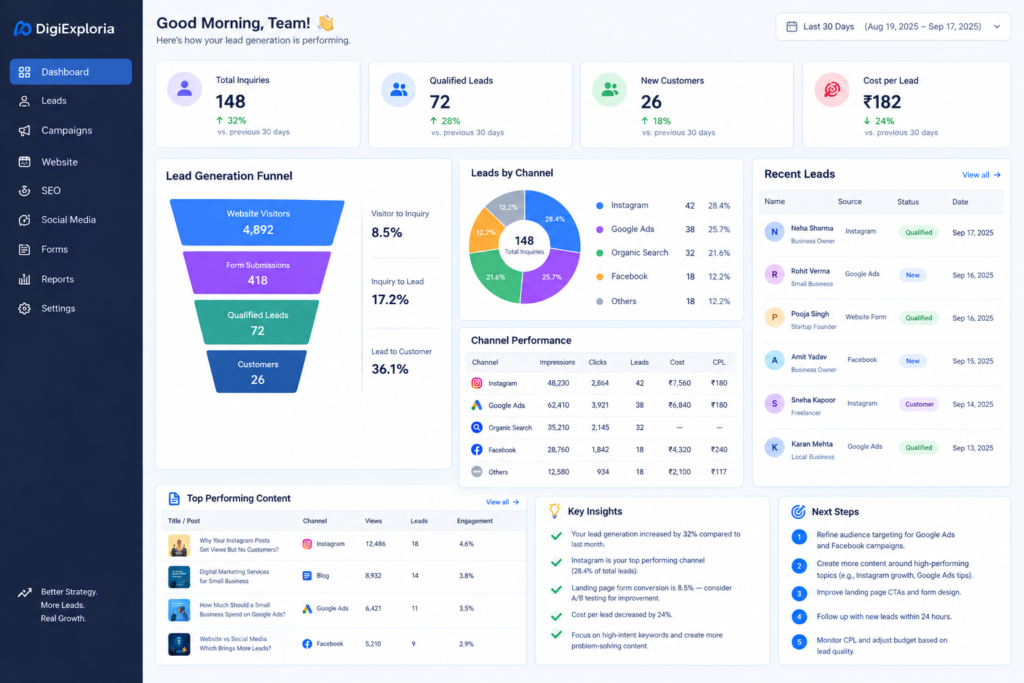
This helps you understand which channels are generating actual business rather than simply generating activity.
9. Follow Up Consistently
Finally, don’t lose leads after successfully generating them.
Respond to inquiries promptly, answer questions, provide relevant information, and follow up when appropriate. Keep track of conversations so potential customers don’t disappear simply because nobody contacted them again.
This is especially important when someone is interested but isn’t ready to purchase immediately.
Build a Complete Lead-Generation System
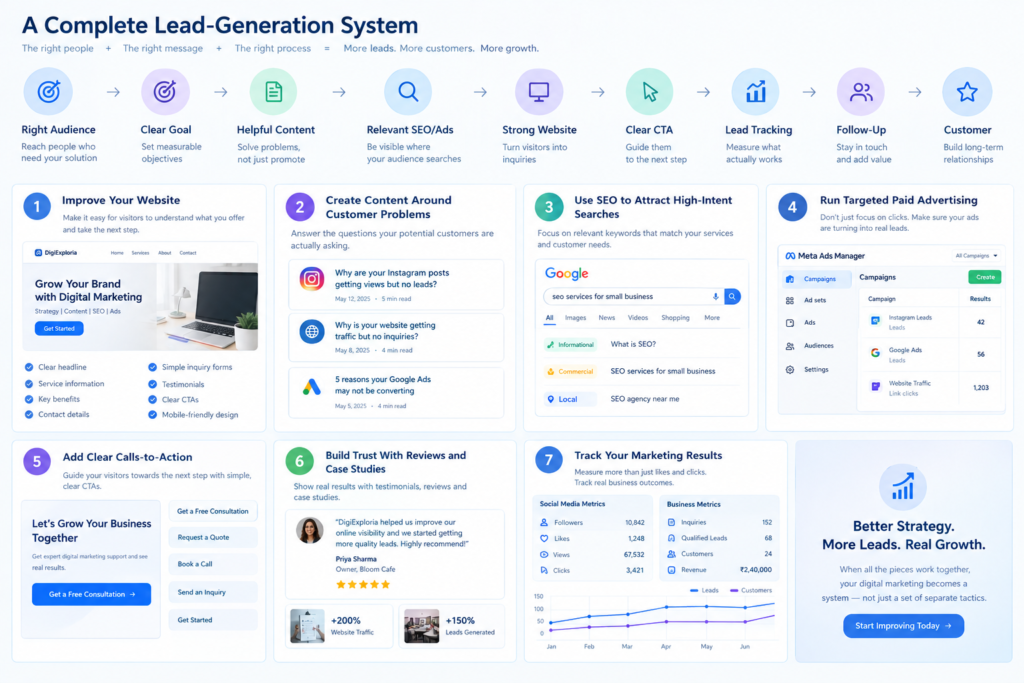
If your digital marketing not generating leads consistently, don’t immediately assume that you need to post more or increase your advertising budget.
Look at the complete journey:
Right Audience → Clear Goal → Helpful Content → Relevant SEO/Ads → Strong Website → Clear CTA → Lead Tracking → Follow-Up → Customer
When these pieces work together, digital marketing becomes more than a collection of posts, keywords, and advertisements.
It becomes a structured system designed to attract the right people, build trust, and create opportunities for your business.
And remember: improving lead generation is not about finding one magic strategy. It is about continuously testing, measuring, learning, and improving each stage of the customer journey.
Ways to Increase Online Leads
Once you understand where your lead-generation process is breaking down, you can start making practical improvements.
If your digital marketing not generating leads problem is affecting your business, use the following checklist to review each part of your online presence.
✅ Improve Your Website
Your website should make it easy for visitors to understand what you offer and what they should do next.
Check whether your website has:
- A clear headline
- Easy-to-understand service information
- Strong benefits
- Visible contact details
- Simple inquiry forms
- Customer reviews or testimonials
- Clear calls-to-action
- A mobile-friendly design
A visitor shouldn’t have to search through multiple pages to figure out how to contact you.
✅ Create Content Around Customer Problems
Instead of creating content simply to stay active on social media, identify the problems your potential customers are actually facing.
For example, a digital marketing agency could create content around:
- “Why are your Instagram posts getting views but no leads?”
- “Why is your website getting traffic but no inquiries?”
- “5 reasons your Google Ads may not be converting”
This type of content can attract people who are already looking for solutions.
✅ Use SEO to Attract High-Intent Searches
SEO can bring visitors to your website, but the goal shouldn’t be traffic alone.
Focus on relevant searches connected to your services and customer needs. Commercial and transactional keywords can help you reach people who are closer to taking action.
For example:
Informational: “What is SEO?”
Commercial: “SEO services for small business”
Local: “SEO agency near me”
Connect these searches to useful content and relevant service or landing pages.
✅ Run Targeted Paid Advertising
Paid advertising can help you reach specific audiences, but your campaigns need more than a large budget.
Review your:
- Audience
- Campaign objective
- Ad message
- Creative
- Offer
- Landing page
- Conversion tracking
If your ads are producing clicks but very few inquiries, increasing the budget may simply increase the number of unconverted visitors.
✅ Add Clear Calls-to-Action
Every important marketing touchpoint should guide people toward a next step.
Use CTAs such as:
Get a Free Consultation
Request a Quote
Book a Call
Send an Inquiry
Get Started
Don’t assume visitors automatically know what you want them to do.
✅ Build Trust With Reviews and Case Studies
People are more comfortable contacting a business when they can see evidence of its work.
Add relevant:
- Customer reviews
- Testimonials
- Case studies
- Before-and-after examples
- Portfolio work
- Results or measurable outcomes
Social proof can help reduce uncertainty when someone is considering your product or service.
✅ Track Your Marketing Results
Finally, track what happens after someone interacts with your marketing.
Don’t measure only:
Followers → Likes → Views → Clicks
Also measure:
Inquiries → Qualified Leads → Customers → Revenue
If you discover that your digital marketing not generating leads consistently, your data can help you identify which part of the customer journey needs attention.
10. How to Know What Is Stopping Your Business From Getting Leads
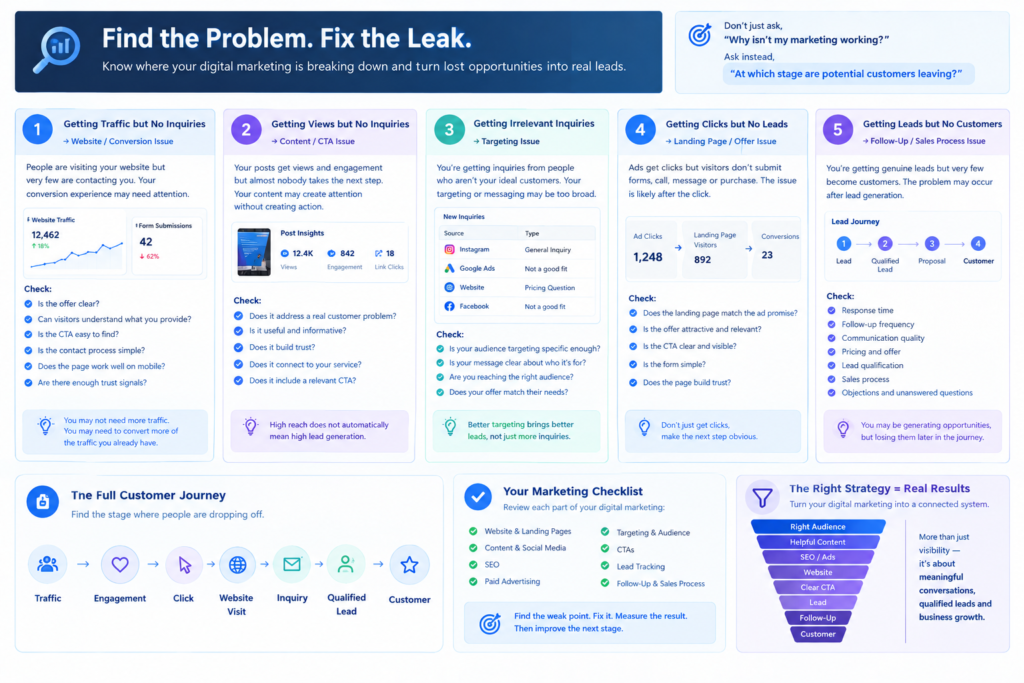
Sometimes the problem isn’t obvious. You may know that you’re not getting enough customers, but you don’t know whether the problem is your content, website, SEO, advertising, targeting, or follow-up.
A simple way to diagnose the problem is to look at what happens at each stage.
Getting Traffic but No Inquiries → Website/Conversion Issue
If people are visiting your website but very few are contacting you, examine your conversion experience.
Ask:
- Is the offer clear?
- Can visitors immediately understand what you provide?
- Is the CTA easy to find?
- Is the contact process simple?
- Does the page work well on mobile?
- Are there enough trust signals?
You may not need more traffic. You may need to convert more of the traffic you already have.
Getting Views but No Inquiries → Content/CTA Issue
If your posts receive views and engagement but almost nobody takes the next step, your content may be creating attention without creating action.
Check whether your content:
- Addresses a genuine customer problem
- Provides useful information
- Builds trust
- Connects naturally to your service
- Includes a relevant CTA
High reach does not automatically mean high lead generation.
Getting Irrelevant Inquiries → Targeting Issue
If you’re receiving inquiries from people who aren’t suitable customers, review your audience targeting and messaging.
Your content and advertising may be reaching too broad an audience, or your message may not clearly communicate who your product or service is designed for.
Getting Clicks but No Leads → Landing Page/Offer Issue
When ads generate clicks but visitors don’t submit forms, call, message, or purchase, examine what happens after the click.
Compare the:
Ad Promise → Landing Page → Offer → CTA
The landing page should deliver what the advertisement promised and make the next step clear.
Getting Leads but No Customers → Follow-Up/Sales Process Issue
If your business is receiving genuine leads but very few become customers, the problem may occur after lead generation.
Review:
- Response time
- Follow-up frequency
- Communication quality
- Pricing and offer
- Lead qualification
- Sales process
- Objections and unanswered questions
Remember, digital marketing not generating leads is only one possible problem. Sometimes the marketing is generating opportunities, but the business is losing them later in the customer journey.
Find the Leak Before You Spend More
Before increasing your advertising budget or posting more frequently, identify where the customer journey is breaking down:
Traffic → Engagement → Click → Website Visit → Inquiry → Qualified Lead → Customer
The stage where people start dropping off gives you a useful starting point for improvement.
Instead of asking, “Why isn’t my marketing working?”, ask:
“At which stage are potential customers leaving?”
That question can turn a confusing marketing problem into a specific problem you can actually solve.
Final Thoughts: Turn Your Digital Marketing Into a Lead-Generating System
If your digital marketing not generating leads, the answer isn’t always to post more, spend more on ads, or chase higher website traffic.
The real question is whether all the parts of your marketing are working together.
Digital marketing should not be treated as a collection of separate activities.
Your social media content, SEO, paid advertising, website, landing pages, CTAs, and follow-up process should all contribute to the same customer journey.
Think of it as a simple system:
Right Audience → Helpful Content → SEO/Ads → Website → Clear CTA → Lead → Follow-Up → Customer
Every Channel Should Have a Purpose
Before investing more time or money into a marketing channel, ask what role it plays in your strategy.
Your:
- Social media can build awareness, engagement, and trust.
- Content can answer customer questions and demonstrate expertise.
- SEO can help people discover your business through relevant searches.
- Paid advertising can reach targeted audiences and generate specific actions.
- Website and landing pages can turn visitors into inquiries.
- CTAs can guide people toward the next step.
- Follow-up can help turn interested prospects into customers.
When these elements are disconnected, you may get activity without meaningful business results.
Review Your Marketing Funnel Regularly
Your marketing funnel shouldn’t be something you set up once and forget.
Review it regularly and ask:
Are we reaching the right people?
Are we creating content around their real problems?
Are we attracting relevant website traffic?
Are visitors taking action?
Are our ads generating qualified leads?
Are we following up with inquiries?
Which marketing activities are actually producing customers?
These questions can help you identify where potential customers are dropping out of the journey.
Stop Focusing Only on More. Start Focusing on Better.
More followers don’t automatically mean more customers.
More website traffic doesn’t automatically mean more sales.
More ad clicks don’t automatically mean more leads.
The goal is to create a connected system where the right people discover your business, find useful information, understand your value, take a clear next step, and receive timely follow-up.
So, if your digital marketing not generating leads, don’t immediately start doing more of everything.
Find the weak point.
Fix it.
Measure the result.
Then improve the next part of the journey.
Because effective digital marketing isn’t about simply being visible online. It’s about turning visibility into meaningful conversations, qualified leads, and opportunities for business growth.