
Here is the introduction written to fit the style and structure we can maintain throughout the rest of your blog. I’ve kept the keyword “SEO Competitive Analysis” natural and included current SEO data to make the opening more useful.
In SEO, knowing what your competitors are doing can be just as important as knowing what your own website needs. SEO Competitive Analysis is the process of studying websites that compete with you in search results to understand how they are ranking, what keywords they target, what content they create, and where they are earning backlinks.
Instead of guessing what might work, competitor research helps you identify strategies and opportunities that are already visible in the search results.
Why does this matter? Search visibility can have a major impact on website traffic.
According to an Ahrefs analysis of billions of Google Search Console clicks, 96.98% of desktop clicks in the U.S. occurred within the top 10 search results in August 2025, while mobile clicks were even higher at 97.56%. [Resource]
This means that simply having a website is not enough—you need to understand what helps competing pages appear where people are actually searching.
One important point is that business competitors and SEO competitors are not always the same. A business competitor may sell similar products or services, while an SEO competitor is any website competing for the same search queries.
For example, a business website may compete in search results with a blog, review website, marketplace, or industry publication even if they do not offer the same product or service. [Resource]
A well-planned SEO Competitive Analysis gives you a clearer picture of where your website stands and where improvements may be possible.
You can discover keywords competitors rank for, examine the content helping them attract visitors, study their backlink profiles, and uncover topics your own website has not covered yet.
In this guide, we’ll break the process into practical steps: finding your SEO competitors, analyzing competitor keywords, checking competitor backlinks, identifying SEO content gaps, and turning those findings into an actionable SEO strategy.
By the end, you’ll have a structured approach to using competitor research not to copy other websites, but to understand the search landscape and make smarter decisions for your own SEO strategy.
This introduction sets up the terminology and workflow we can reuse consistently in the next sections. Send me your first H2 outline, and I’ll continue with the same tone and keyword approach.
Learn more about our SEO Services click here [digiexploria]
What Is an SEO Competitive Analysis?

An SEO Competitive Analysis is the process of studying websites that compete with your pages in search results to understand why they are ranking and where your website has opportunities to improve.
Instead of looking only at your own SEO performance, you compare your website with pages already competing for the same search queries. This can reveal differences in keyword targeting, content, backlinks, search intent, and website structure.
The main purpose of an SEO Competitive Analysis is not to copy what another website is doing. It is to understand what is working in your search landscape and use those insights to make better SEO decisions.
For example, if several competitors consistently rank for topics that your website has not covered, that may indicate a content opportunity. Similarly, if competitors have backlinks from relevant industry websites, examining those links can help you understand potential link-building opportunities.
So, what exactly should you compare? Start with keywords. Look at the search terms your competitors rank for and identify relevant keywords where your website has weaker visibility or does not appear at all.
Next, examine search rankings to understand which pages perform well and which topics generate visibility.
Content is another important area. Look at the subjects competitors cover, the depth of their articles, their headings, page formats, and how well their content matches what searchers are looking for.
Search intent is particularly important because ranking pages often provide clues about what users expect when they search for a particular query.
You should also analyze backlinks. Backlinks can provide useful information about which websites reference your competitors and what types of content attract links.
Finally, review website structure, including important sections, categories, internal linking, and pages that appear to attract organic search traffic. Tools such as Ahrefs can help examine competitors’ keywords, backlinks, site structure, and top-performing pages.
A well-executed SEO Competitive Analysis can turn competitor research into practical opportunities. You may discover missing keywords, uncovered topics, backlink opportunities, or pages that need stronger optimization.
The goal is to turn these findings into an action plan: improve existing pages, create useful new content, strengthen relevant backlinks, and better match search intent.
In simple terms, SEO Competitive Analysis helps answer one important question: What are the websites performing well in search doing differently, and what can your website learn from the search results?
How to Find Your SEO Competitors?
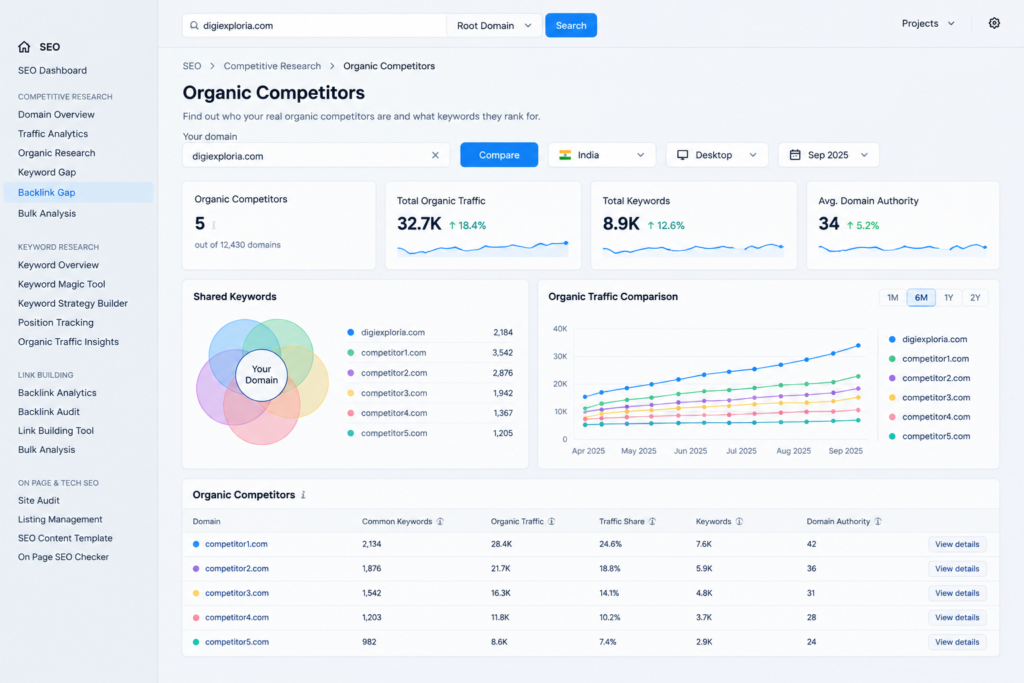
Before you can study your competition, you first need to know who your actual SEO competitors are.
This is where an SEO Competitive Analysis begins. Your SEO competitors are not necessarily the businesses that sell the same products or services as you. Instead, they are websites that compete with your pages for the same keywords and search results.
A blog, marketplace, review website, or industry publication can therefore be an SEO competitor even when it is not a direct business rival.
One of the simplest ways to find them is through Google itself. Start by making a list of around 5–10 important keywords that your potential customers might search for. Search each keyword and examine the first page of the SERPs (Search Engine Results Pages).
Record the domains that appear repeatedly, especially those ranking near the top for several relevant searches. These recurring websites are strong candidates for your SEO competitor list.
For example, if you offer digital marketing services and target keywords such as “digital marketing services,” “SEO services,” or “social media marketing services,” the websites appearing consistently for these searches are worth investigating—even if some of them offer a slightly different service.
You can also use SEO tools to make this research faster. Platforms such as Ahrefs and Semrush provide competitor reports based on shared organic keywords.
Ahrefs’ Organic Competitors report identifies websites ranking in the top 10 for the same keywords that generate traffic for your site, while Semrush identifies organic competitors based on common keywords in Google’s top 20 results.
However, don’t rely entirely on automated tools. A strong SEO Competitive Analysis combines tool-generated data with manual SERP research.
Tools can help you discover competitors at scale, while Google searches help you understand the actual pages and types of websites appearing for your most important queries.
It’s also useful to separate direct business competitors from search competitors. Your direct competitors may offer the same services as you, while search competitors simply compete for your target keywords. Keeping both lists separate makes your analysis more accurate.
Finally, create a shortlist of around 3–5 highly relevant SEO competitors and record their domains, important keywords, ranking pages, content topics, and other useful observations. This gives you a manageable group to study in detail.
Once you have identified your competitors, your SEO Competitive Analysis can move to the next stage: discovering which keywords are bringing them search visibility and which opportunities your website may be missing.
How to Analyze Competitor Keywords?
Once you have identified your SEO competitors, the next step is to understand which keywords are helping them appear in search results.
Competitor keyword analysis means examining the search terms your competitors rank for and comparing them with the keywords your own website targets. As part of an SEO Competitive Analysis, this can reveal topics and search terms that may otherwise be easy to overlook.
Start by entering a competitor’s website into an SEO research tool such as Semrush or Ahrefs. These tools can show the keywords a competitor ranks for, the pages ranking for those terms, their positions, and other useful metrics.
Semrush’s Keyword Gap tool, for example, can identify keywords your competitors rank for but your website does not.
Next, compare your competitor’s keyword profile with your own. Don’t simply collect thousands of keywords and try to target all of them. Instead, organize the data into useful categories.
Look for high-value keywords that are closely connected to your products, services, or audience. Then examine long-tail keywords, which are usually more specific and can reveal highly targeted search needs. You should also look for low-competition keywords where your website may have a realistic opportunity to gain visibility.
One of the most useful categories is keywords your website does not currently rank for. These are often called keyword gaps. Ahrefs describes Content Gap as a way to find keywords competitors rank for that your website does not, helping uncover potential content opportunities.
However, search volume and competition should not be your only considerations. Search intent matters just as much. Ask whether the person searching is looking for information, comparing options, searching for a specific website, or ready to purchase.
A keyword with high search volume may have little business value if its intent does not match your offering. Semrush similarly recommends considering relevance and search intent rather than focusing only on volume or keyword difficulty.
This is where keyword gap analysis becomes an important part of your SEO Competitive Analysis. Create a spreadsheet containing the keyword, search intent, competitor ranking position, your current position, search volume, difficulty, and potential content opportunity.
Then prioritize terms that are relevant, realistic, and useful to your audience.
Remember, the goal is not to copy your competitors’ keyword strategy. It is to understand where they have visibility, discover gaps in your own strategy, and decide which opportunities are worth pursuing.
A thoughtful SEO Competitive Analysis turns competitor keyword data into a practical roadmap.
Instead of asking, “Which keywords are my competitors using?” you can ask the more valuable question: “Which relevant search opportunities can I realistically create better content for?
How to Analyze Competitor Backlinks?
After analyzing competitor keywords, the next step in an SEO Competitive Analysis is to examine their backlinks.
A backlink is a link from another website pointing to a page on your website. When you analyze competitor backlinks, you are essentially asking: Which websites are linking to my competitors, and why?
This can reveal useful information about their link-building strategies and potential opportunities for your own website.
Backlinks are important because they can help search engines discover and evaluate pages. However, the number of backlinks alone does not tell you whether a link is valuable. Relevance, authority, context, and the quality of the linking website all matter.
Ahrefs notes that backlinks from relevant websites and pages can be more valuable than links from completely unrelated sources.
To begin your SEO Competitive Analysis, enter a competitor’s domain into a backlink research tool such as Ahrefs. Its Backlinks report can show the pages linking to a competitor, the referring page, anchor text, and target URL.
You can then create a list of websites that repeatedly link to your competitors.
Pay particular attention to referring domains. A referring domain is a unique website that provides one or more backlinks.
For example, if five different pages on one website link to your competitor, those links still represent one referring domain. Looking at referring domains rather than only total backlinks gives you a clearer picture of how widely a competitor’s content is being referenced.
Next, assess the quality and relevance of these websites. Look for industry publications, relevant blogs, professional organizations, local websites, resource pages, and other credible sources.
Ahrefs’ competitor link analysis process recommends looking for common referring domains that link to multiple competitors but not to your website.
These common domains can become potential backlink opportunities.
For example, if three competitors have earned links from the same industry publication and your business has genuinely useful content that fits its audience, you could consider reaching out with a relevant resource. Tools such as Link Intersect can help identify websites that link to competitors but not to your own site.
At the same time, don’t try to copy every backlink you find. Avoid irrelevant, suspicious, or low-quality links simply because a competitor has them. Your goal is to build a relevant and trustworthy backlink profile, not to collect links as quickly as possible.
A useful SEO Competitive Analysis should therefore compare your backlink profile with competitors across factors such as referring domains, link relevance, linking pages, anchor text, and content attracting the most links.
The final question should be: Which legitimate link opportunities can strengthen my website and provide genuine value to users?
How to Identify SEO Content Gaps?
Finding competitor keywords is useful, but keywords alone do not tell the whole story. The next step in an SEO Competitive Analysis is identifying content gaps—topics, questions, or information that your audience needs but your website does not cover adequately.
A content gap can exist when you have no page on a relevant topic, when your existing content is too thin or outdated, or when your page does not satisfy the search intent behind a query.
It is important to understand the difference between a keyword gap and a content gap. A keyword gap usually refers to search terms that competitors rank for while your website does not. A content gap is broader.
It can involve an entire topic, missing questions, weak explanations, outdated information, or content that does not match what users are actually looking for.
In other words, a keyword gap can point you toward an opportunity, while content gap analysis helps you understand what information your audience is missing.
To find these gaps, start by analyzing your competitors’ blog posts, landing pages, guides, and other important content.
Look for topics they cover that your website has not addressed. Tools such as Ahrefs’ Content Gap can compare competitor websites and identify keywords they rank for that your site does not, providing a starting point for discovering new content opportunities.
Next, examine the actual content rather than simply copying its keywords. Ask questions such as: Does the competitor answer important questions that my page ignores? Is their information more current? Do they explain the topic more clearly? Are they addressing a different search intent? These questions can uncover several types of gaps, including missing topics, unanswered questions, outdated information, weak or incomplete content, and intent gaps.
Semrush identifies topic, intent, quality, and originality gaps as key areas to consider when evaluating content.
For example, imagine your website has a basic article about “social media marketing,” while competitors cover platform-specific strategies, content calendars, advertising tips, measurement methods, and common mistakes.
Your article may technically target the same topic, but it could still have a content depth gap.
The next step is to turn these findings into useful content ideas. Some gaps may require a completely new blog post, while others can be addressed by updating an existing page, adding a missing section, answering common questions, or improving outdated information.
A strong SEO Competitive Analysis should therefore focus on more than what competitors are ranking for. It should help you understand what your audience wants to know and where your website can provide a more useful answer.
When you consistently turn these gaps into valuable, relevant content, competitor research becomes a practical content strategy rather than simply a research exercise.
How to Analyze Competitor Content?
After identifying competitor keywords, backlinks, and content gaps, the next step in an SEO Competitive Analysis is to examine the actual content that is performing well in search results.
This is where you move beyond numbers and start understanding what competitors are doing to satisfy their audience.
Begin by studying the content structure of their top-ranking pages. Look at the title, introduction, H2s, H3s, paragraphs, lists, tables, FAQs, and calls to action.
Pay special attention to the H2s because they can reveal the subtopics a competitor is covering. If several high-ranking pages discuss similar subtopics, it may indicate that those topics are important to the search intent behind that query.
Semrush recommends mapping competitor H2s and examining their page structure as part of on-page competitor analysis.
Next, evaluate their headlines and content depth. Ask yourself: Does the headline clearly communicate the value of the page? Does the article answer the main question quickly?
Does it provide examples, statistics, original insights, or practical steps? You should also consider readability. A 2,000-word article is not automatically better than a 1,000-word article if it contains unnecessary information or fails to answer the reader’s question.
Don’t ignore different content formats. Competitors may use images, videos, comparison tables, infographics, FAQs, checklists, or step-by-step instructions to make their content more useful.
Ahrefs’ Site Explorer, for example, can help identify competitors’ top-performing pages and the topics and pages attracting organic traffic and backlinks.
Most importantly, identify the search intent their content satisfies. Is the reader looking for information, comparing options, finding a specific service, or preparing to make a purchase?
Your goal isn’t to copy the competitor’s article. Instead, find ways to make your own content clearer, more complete, more current, or more useful.
SEO Competitive Analysis Tools You Can Use
The right tools can make an SEO Competitive Analysis much faster, but each tool serves a different purpose.
Google Search is the simplest starting point. Search your target keywords and manually study the websites, page formats, headlines, featured results, and content types appearing in the SERPs. It gives you a direct view of what Google is currently showing for a query.
Google Search Console is especially useful for analyzing your own website. It provides data about your site’s search performance, including queries, clicks, impressions, and positions.
This information can be compared with competitor research to identify areas where your site needs improvement.
Ahrefs is particularly useful for competitor keywords, top-performing pages, backlinks, referring domains, and content opportunities. Its Site Explorer allows you to examine a competitor’s organic search performance and backlink profile.
Semrush provides several competitor research features, including organic keyword analysis, competitor pages, backlinks, and keyword gaps.
Its tools can help identify the search terms competitors rank for and the opportunities your website may be missing.
Moz can help with competitor and keyword research, including comparing ranking opportunities and analyzing link-related SEO data.
Ubersuggest can also support keyword research, competitor analysis, content ideas, and backlink research, making it useful for marketers who want a simpler research workflow.
The best approach is not to use every tool at once. Choose tools according to your objective: Google for real SERP research, Search Console for your own performance, and dedicated SEO platforms for deeper competitor keyword, content, and backlink analysis.
Used together, these tools make your SEO Competitive Analysis more organized and actionable, helping you move from competitor observations to specific SEO improvements.
How to Turn Competitor Analysis Into an SEO Strategy?
Collecting competitor data is only the first step. The real value of an SEO Competitive Analysis comes from turning those findings into actions that improve your website.
Instead of trying to replicate everything your competitors do, use the information to decide where your SEO efforts can have the most value.
Start by prioritizing keyword opportunities. You may discover hundreds or even thousands of keywords during competitor research, but not all of them deserve your attention.
Focus on keywords that are relevant to your business, match your audience’s search intent, and offer a realistic opportunity for your website. Consider factors such as search intent, competition, relevance, and the current strength of your pages before choosing which keywords to target.
Next, turn identified content gaps into useful content. If your competitors are covering questions or topics that your website has missed, create comprehensive resources that genuinely help readers.
At the same time, review your existing pages. Some opportunities may not require a new article—you may simply need to expand an existing page, update outdated information, improve headings, add FAQs, or make the content easier to understand.
Your SEO Competitive Analysis should also guide your backlink strategy. If relevant websites are linking to competitors because of useful guides, research, tools, or original resources, consider creating something valuable enough to earn similar attention.
Focus on relevance and quality rather than trying to acquire as many backlinks as possible.
Another important step is optimizing for search intent. Before updating a page, review the current search results and understand what users expect.
If most results are detailed guides, a short promotional page may not satisfy the same intent. Align your content format, depth, and purpose with what searchers are actually looking for while still providing your own useful perspective.
SEO is also an ongoing process. Competitors can publish new content, update old pages, earn backlinks, and target new keywords at any time.
Regularly monitoring these changes can help you spot emerging opportunities before they become part of the crowded search landscape.
Finally, track your own rankings and performance over time. Monitor important keywords, organic clicks, impressions, conversions, and the performance of pages you have optimized.
Google Search Console can help you understand how your website performs in Google Search, while SEO platforms can provide additional competitor and ranking insights.
A successful SEO Competitive Analysis should therefore end with a clear action plan: prioritize → create → optimize → build → monitor → measure.
The goal is not simply to know what competitors are doing, but to turn that knowledge into continuous improvements for your own website.
Common SEO Competitive Analysis Mistakes to Avoid
A well-planned SEO Competitive Analysis can uncover valuable opportunities, but the results are only useful when you interpret them correctly. Many businesses make the mistake of treating competitor research as a checklist instead of using it to understand their own audience, website, and SEO opportunities.
Here are some common mistakes to avoid.
1. Copying competitors instead of learning from them
Your competitors can provide useful ideas, but copying their content, page structure, keywords, or strategy will not create a unique advantage. Instead, study what they are doing successfully and look for ways to provide something more useful, clearer, more relevant, or more original.
2. Focusing only on rankings
Rankings are important, but they are not the entire picture. A page ranking highly for a keyword does not automatically mean it is generating meaningful business results. During an SEO Competitive Analysis, also consider organic clicks, impressions, relevant traffic, conversions, content quality, backlinks, and search intent.
3. Targeting every keyword competitors rank for
Finding hundreds of competitor keywords can be exciting, but targeting all of them is rarely practical. Some keywords may be irrelevant to your audience, have the wrong search intent, or have little connection to your products or services.
Prioritize keywords based on relevance, opportunity, and business value.
4. Ignoring search intent
A keyword may look attractive because it has significant search demand, but the searcher’s goal matters just as much.
Before creating content, examine the current SERPs and determine whether users are looking for information, comparisons, products, services, or a specific website. Your content should satisfy the appropriate intent.
5. Building low-quality backlinks
Competitor backlink analysis should not become a race to collect links.
Avoid pursuing irrelevant, manipulative, or questionable backlink opportunities simply because a competitor has them. Google’s SEO guidance emphasizes creating helpful content and avoiding link practices intended primarily to manipulate rankings.
6. Forgetting content quality
Keyword research and technical optimization cannot replace genuinely useful content. Your goal should be to answer the user’s question clearly, accurately, and completely.
Add original insights, examples, current information, visuals, or practical steps when they genuinely improve the experience.
7. Analyzing competitors only once
Search results and competitor strategies change over time. New pages can appear, existing content can be updated, and competitors can target new topics. Treat competitor research as an ongoing process rather than a one-time task.
Ultimately, an effective SEO Competitive Analysis is about learning, not copying.
When you combine competitor insights with audience needs, quality content, relevant keywords, and ethical SEO practices, your research becomes a long-term source of opportunities rather than a one-time report.
SEO Competitive Analysis Checklist
Once you understand the different stages of an SEO Competitive Analysis, it helps to have a simple checklist you can return to whenever you analyze your search competitors. You don’t need to complete everything in one sitting.
Work through each step, record your findings, and turn the most relevant insights into specific SEO actions.
Use this checklist to make sure you haven’t missed an important part of the process:
☐ Find your SEO competitors
Identify websites competing for the same keywords and search queries as your website.
☐ Analyze competitor keywords
Find the keywords competitors rank for and identify terms that are relevant to your audience and business.
☐ Identify keyword gaps
Look for valuable keywords where competitors have visibility but your website does not.
☐ Analyze competitor backlinks
Review the websites linking to competitors and identify relevant, legitimate opportunities for your own website.
☐ Identify SEO content gaps
Find important topics, questions, and information that competitors cover but your website is missing or could cover more effectively.
☐ Study competitor content
Examine their headlines, H2s, content structure, depth, visuals, FAQs, and other formats to understand how they address search intent.
☐ Compare website performance
Review your rankings, organic traffic, impressions, clicks, conversions, and other relevant SEO metrics alongside your competitor research.
☐ Find new SEO opportunities
Turn your research into opportunities such as new keywords, content ideas, page improvements, internal linking opportunities, and relevant backlink prospects.
☐ Create an action plan
Prioritize the opportunities that are most relevant and realistic for your website. Assign tasks, deadlines, and measurable goals.
☐ Monitor competitors regularly
Repeat your research periodically to identify new content, changing rankings, emerging keywords, and shifts in the search landscape.
This checklist turns SEO Competitive Analysis from a collection of research activities into a repeatable process.
You can save it as a spreadsheet or document and update it whenever you conduct a new competitor review.
The most important thing is not simply checking every box. Focus on the insights behind each step and ask how they can improve your website.
A keyword gap might become a new article, a content gap could lead to an improved service page, and a useful backlink opportunity could support your authority-building strategy.
With a structured approach, competitor research becomes easier to repeat, measure, and connect with your broader SEO strategy.
Conclusion
An effective SEO Competitive Analysis is more than checking which websites rank above you.
It is a way to understand the search landscape, discover opportunities, and make more informed decisions about your own SEO strategy.
By studying competitor keywords, content, backlinks, search intent, and website structure, you can identify areas where your website is performing well and where there is room to improve.
The process becomes much easier when you follow a clear framework:
Find → Analyze → Identify Gaps → Optimize → Monitor
First, find the websites competing for your target search queries. Remember that an SEO competitor does not always have to be a direct business competitor.
Next, analyze their keywords, content, backlinks, rankings, and search intent. Then, identify gaps that could represent opportunities for your website—whether that means an unanswered question, an important keyword, a missing topic, or a relevant backlink opportunity.
Once you know where the opportunities are, optimize your existing pages and create useful new content based on what your audience actually needs.
Improve your headings, strengthen content, match search intent, update outdated information, and build relevant backlinks naturally. Most importantly, don’t optimize simply because a competitor is doing something.
Make changes because they improve the experience and usefulness of your own website.
Finally, monitor your results. SEO is not a one-time activity. Search results change, competitors publish new content, and user behavior evolves.
Regularly reviewing your rankings, organic clicks, impressions, conversions, and competitor activity can help you recognize new opportunities and adjust your strategy over time.
The biggest lesson from an SEO Competitive Analysis is simple: competitor research should inspire better decisions, not encourage imitation.
Your competitors can show you what opportunities exist, but your job is to create something more relevant, useful, and valuable for your own audience.
At DigiExploria, the goal is to turn digital marketing ideas into strategies that help brands become more visible and connect with the right audience.
If you’re ready to improve your search visibility with a smarter, research-driven SEO strategy, explore our SEO Services and grow your digital presence with DigiExploria.